Welcome back—Jonoren here.
Today’s instalment of our Position Best 3 series celebrates the architects of pure chaos out wide: the greatest wingers who tore up the touchline.
To narrow down this list, I set three clear criteria:
1. Active during the golden era of 1994 to 2006—the years that forged my deepest tactical fascination with world football.
2. Strictly aligned with the theme: wide specialists who dismantled defences in 1v1 duels.
3. Recognised legends of world football.
A candid confession: while framed as a ‘Top 3’, these icons are impossible to separate. In truth, all three stand shoulder-to-shoulder on the top step of the podium.
- The Geometry of Wide Duels: Why Dominating the Touchline Decides Matches
- 1. Ryan Giggs | The Japanese Katana & Master of Area 11
- 2. Marc Overmars | The Two-Footed Speedster & Dual-Threat Pioneer
- 3. Arjen Robben | The Inverted Cut-In Perfected
- Tactical Summary: The Evolution of Wing Play & Its Modern Heir
The Geometry of Wide Duels: Why Dominating the Touchline Decides Matches

Football is celebrated as the ultimate 11-versus-11 team sport. Yet examine any attacking move closely, and the match inevitably breaks down into a relentless series of 1v1 duels.
When an attacker beats their marker 1v1, it instantly shatters the opposition’s defensive shape, creating an immediate numerical overload (2v1 or 3v2). Conversely, losing an individual duel leaves the rest-defence wide open. In modern football analytics, one universal law holds firm: maximising your 1v1 win rate directly boosts your chances of winning the match.
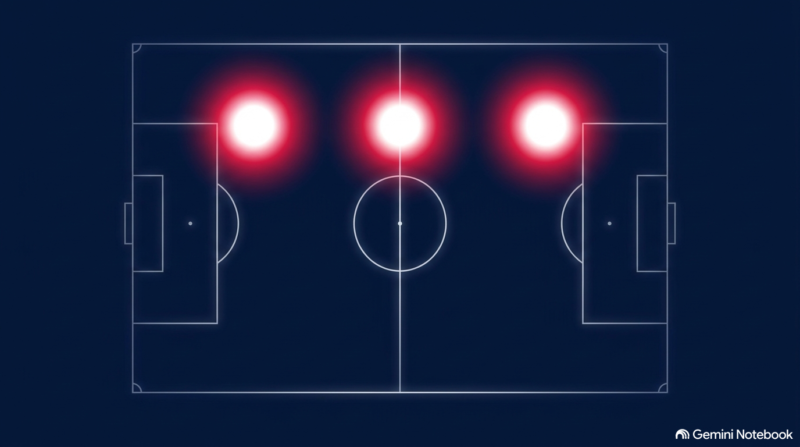
Nowhere on the pitch offers a purer, more expansive stage for 1v1 duels than the touchline. Breaking down a compact block through a congested centre demands intricate combinations. Out on the chalk, however, an explosive dribbler has the isolated space to take on their full-back directly.
As explored in our tactical column, The History of Football Wingers: From Touchline Sprinters to the Inverted Revolution, the winger has evolved over a century—from chalk-on-the-boots crossers in the 2-3-5 Pyramid, to industrious wide midfielders during the pressing revolution, and finally to inverted forwards attacking the half-spaces.
Yet through every tactical shift, the primal soul of the winger has never changed: ‘Receive the ball, run at your marker, leave them clutching at shadows, and carve out decisive chances’.
Below, we profile three icons who defined European football from the 1990s to the 2010s—complete with their career records and tactical ratings.
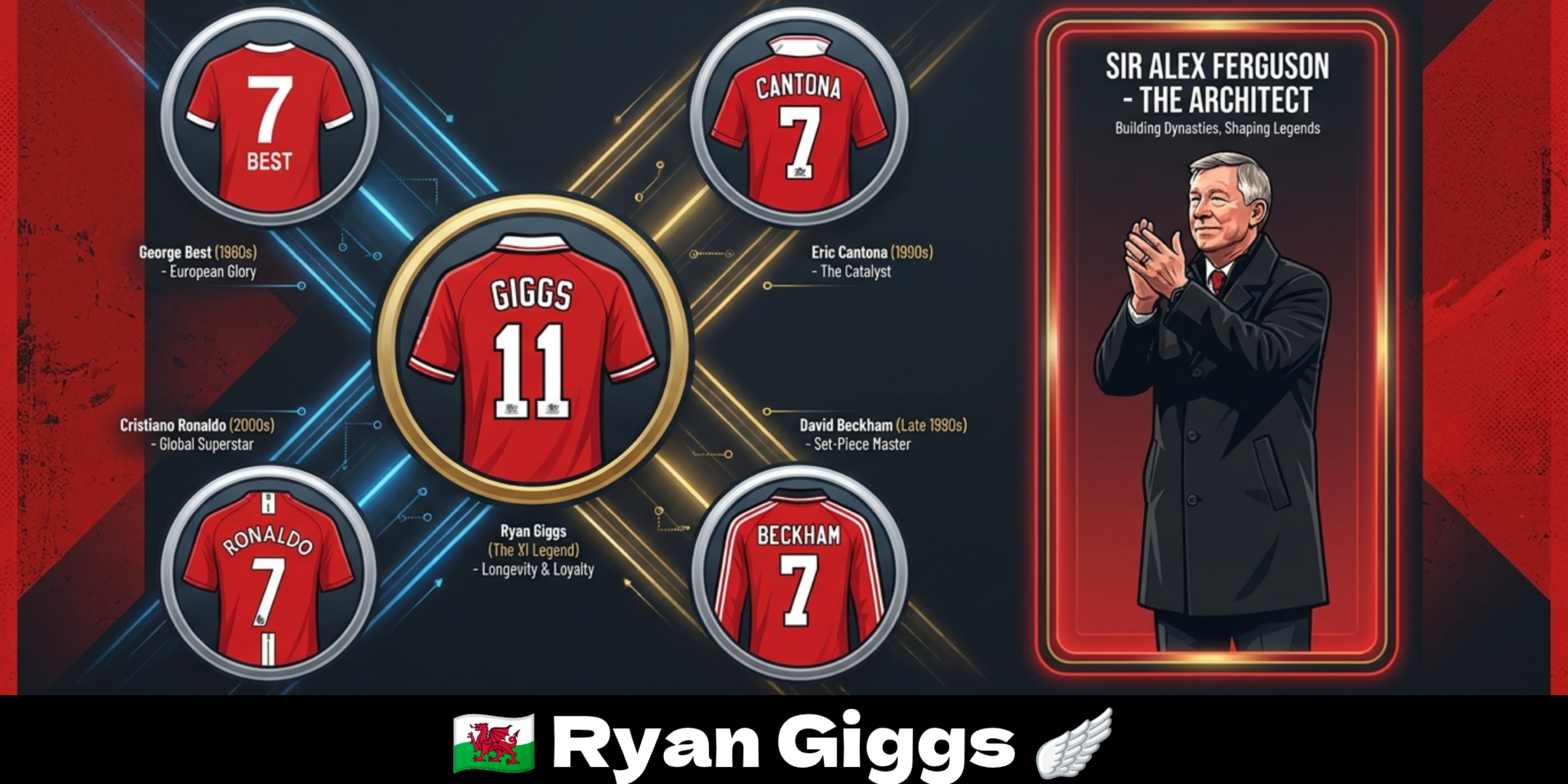
1. Ryan Giggs | The Japanese Katana & Master of Area 11
Ryan Giggs: Complete Career Profile
| Category | Career Benchmarks & Records |
|---|---|
| ① Full Name | Ryan Joseph Giggs |
| ② Nationality & Roots | Wales (Cardiff, Canton district / raised in Salford) |
| ③ Date of Birth | 29 November 1973 |
| ④ Height & Weight | 180 cm (5 ft 11 in) / 72 kg (158 lbs) |
| ⑤ Preferred Foot | Left (Right-handed) |
| ⑥ Primary Positions | Left Winger / Left Midfielder / Central Midfielder (Regista) |
| ⑦ Club Career | Manchester United (1990–2014 / 24 consecutive seasons)• Domestic League: 672 apps, 114 goals (Premier League: 632 apps, 109 goals)• Total Official Club Career: 963 apps, 168 goals (All-time club record) |
| ⑧ International Career | • Wales National Team (1991–2007): 64 caps, 12 goals• Great Britain Olympic Team (2012 London Olympics Captain): 4 apps, 1 goal (Oldest Olympic goalscorer: 38 years, 243 days) |
| ⑨ World Cup Record | Never qualified for FIFA World Cup or UEFA European Championship |
| ⑩ Iconic Shirt Number | No. 11 (Manchester United, Wales, Great Britain) |
| ⑪ Major Honours | • 13 Premier League titles (All-time record)• 4 FA Cups (1993–94, 95–96, 98–99, 2003–04)• 2 UEFA Champions Leagues (1998–99, 2007–08)• 1 Intercontinental Cup (1999 / Final MVP)• 1 FIFA Club World Cup (2008) |
| ⑫ Historic Milestones | • Premier League All-Time Record: 162 Assists• PFA Players’ Player of the Year (2008–09 / at age 35)• PFA Young Player of the Year: 2 times (1991–92, 92–93 / first back-to-back winner)• Zero red cards across 963 matches and 24 seasons for Manchester United |
Tactical Parameter Evaluation: Ryan Giggs
| Attribute | Rating | Tactical Breakdown |
|---|---|---|
| Attacking | ★★★★★ (5/5) | All-time Premier League record 162 assists; scored in 21 consecutive Premier League campaigns. |
| Defending | ★★★☆☆ (3/5) | Dutiful tracking in a 4-4-2; evolved into an astute central shield reading passing lanes in his twilight. |
| Technique | ★★★★★ (5/5) | Velvet first touch with the outside of his boot, sharp balance shifts, and pinpoint curling deliveries. |
| Pace / Deceleration | ★★★★★ (5/5) | Explosive linear stride that never lost velocity while carrying the ball; instant deceleration that froze full-backs. |
| Stamina & Flexibility | ★★★★★ (5/5) | Pioneered sports yoga to rebuild his kinetic chain, maintaining elite match fitness until age 40. |
The Initial Revelation: Captain Tsubasa vs. The Real-Life Katana
For those of us raised on the manga Captain Tsubasa, the archetype of the pure dribbler was Hajime Taki—a touchline specialist who dashed down the wing to whip in crosses. Traditionally, wide men were often seen as supporting acts to glamorous central goalscorers. Yet in the early 1990s, when a young Ryan Giggs burst onto the Old Trafford turf alongside Eric Cantona, he shattered that perception forever.
Carrying the ball at full tilt, his pace never dropped; if anything, he seemed to accelerate with the ball glued to his left instep. His sharp weight shifts and sudden changes of direction left defenders sprawling. While English commentators often likened his incision to a ‘jackknife’, to me his dribbling possessed the elegance and lethal sharpness of a forged Japanese katana.
Former teammate Steve Bruce captured his fluidity best: “He ran like the wind, with effortless grace and complete silence.” Italian legend Alessandro Del Piero offered an even more reverent tribute: “I have only cried twice watching football: the first was Diego Maradona, the second was Ryan Giggs.”
That genius was immortalised on 14 April 1999 in the FA Cup Semi-Final replay against Arsenal, sealing a dramatic 2-1 win. Intercepting a loose pass deep inside his own half in extra time, Giggs drove through midfield, slalomed past Lee Dixon, wrong-footed Tony Adams, evaded Martin Keown, and rifled an unstoppable left-footed strike into the roof of David Seaman’s net—a 60-metre solo run that stands among the greatest goals in football history.
Tactical Mastery: From Touchline Flyer to Cerebral Regista
What separated Giggs from ordinary speedsters was his remarkable longevity. While many explosive wingers fade when their pace declines in their late twenties, Giggs rebuilt his entire game. Battling chronic hamstring injuries, he took up yoga around 2005, transforming his flexibility and core stability.
At age 35 in the 2008–09 season, Sir Alex Ferguson moved him from the touchline into central midfield as a deep-lying playmaker. Rather than relying on blistering pace, Giggs dictated the tempo with 360-degree awareness, disguised body angles, and laser-guided passing—winning the PFA Players’ Player of the Year award.
His all-time Premier League record of 162 assists remains untouchable, sitting more than 40 ahead of second-placed Kevin De Bruyne. Combined with zero red cards across 963 appearances in the world’s most physically demanding league, Giggs set an eternal benchmark as the undisputed ‘Master of Area 11’.
2. Marc Overmars | The Two-Footed Speedster & Dual-Threat Pioneer
Marc Overmars: Complete Career Profile
| Category | Career Benchmarks & Records |
|---|---|
| ① Full Name | Marc Overmars |
| ② Nationality & Roots | Netherlands (Epe, Gelderland province) |
| ③ Date of Birth | 29 March 1973 |
| ④ Height & Weight | 173 cm (5 ft 8 in) / 72 kg (158 lbs) |
| ⑤ Preferred Foot | Right (Virtually two-footed; deployed predominantly on the left flank) |
| ⑥ Primary Positions | Left Winger / Right Winger (Dual-Flank Forward) |
| ⑦ Club Career | • 1990–1991: Go Ahead Eagles• 1991–1992: Willem II• 1992–1997: AFC Ajax (136 league apps, 36 goals)• 1997–2000: Arsenal FC (100 league apps, 25 goals)• 2000–2004: FC Barcelona (97 league apps, 15 goals)• 2008–2009: Go Ahead Eagles (Comeback) |
| ⑧ International Career | Netherlands National Team (1993–2004): 86 caps, 17 goals |
| ⑨ World Cup Record | • 1994 USA (Quarter-finals / FIFA Best Young Player Award)• 1998 France (Semi-finals / 4th place) |
| ⑩ Iconic Shirt Number | No. 11 (Ajax, Arsenal, Barcelona, Netherlands) |
| ⑪ Major Honours | • 1 UEFA Champions League (1994–95, Ajax / Unbeaten)• 3 Eredivisie titles (1993–94, 94–95, 95–96)• 1 Premier League title (1997–98, Arsenal / Domestic Double)• 1 FA Cup (1997–98, Arsenal)• 1 Intercontinental Cup (1995) |
| ⑫ Monikers & Characteristics | The Roadrunner (‘Meep-Meep’) / The TGV / Two-footed dual-threat |
Tactical Parameter Evaluation: Marc Overmars
| Attribute | Rating | Tactical Breakdown |
|---|---|---|
| Attacking | ★★★★★ (5/5) | Decisive match-winner for Ajax and Arsenal; clinical finishing with either boot. |
| Defending | ★★☆☆☆ (2/5) | Executed disciplined counter-pressing triggers within Louis van Gaal’s structured 3-4-3 system. |
| Technique | ★★★★★ (5/5) | Equally lethal striking and crossing with both left and right feet; seamless directional cuts. |
| Pace / Deceleration | ★★★★★ (5/5) | Sub-11-second 100m sprint velocity; explosive first-step acceleration that left defenders flat-footed. |
| Physicality / Durability | ★★★☆☆ (3/5) | Low centre of gravity that rode contact, but endured repeated knee injuries that cut short his peak. |
The Ajax 3-4-3 Laboratory and the Highbury Connection
Marc Overmars is the reason I fell in love with AFC Ajax during the unforgettable 1994–95 campaign. Louis van Gaal’s tactical masterpiece was built around an expansive 3-4-3 diamond: Finidi George hugging the right touchline, and Overmars tearing apart the left. When that youthful Dutch side—averaging just 23 years of age—beat AC Milan 1-0 in the final to lift the European Cup unbeaten, my tactical worldview was forged.
In the summer of 1997, Overmars reunited with Dutch compatriot Dennis Bergkamp at Arsène Wenger’s Arsenal. Their telepathic link was instantaneous, driving Arsenal to the 1997–98 Premier League and FA Cup Double. His iconic breakaway winner in the 1-0 victory over Manchester United at Old Trafford in March 1998 proved the historic tipping point that announced Arsenal’s modern golden era.
Tactical Breakdown: Trapping Full-Backs in the ‘Panic Zone’
Overmars’s supreme tactical weapon was being genuinely two-footed from the left wing. Naturally right-footed, he had honed his left foot to near perfection.
This presented opposing full-backs with an unsolvable dilemma. If a defender showed him the outside, Overmars used his blistering pace to surge down the line and whip in a pinpoint left-footed cross. If they overcompensated to seal the touchline, he cut sharply inside onto his right foot, driving diagonally into the box to bend shots into the far corner. Faced with a winger equally lethal going inside or out at breakneck speed, full-backs were plunged into total paralysis—the panic zone.
This exact blueprint—operating from the left touchline with the threat of both vertical take-ons and inside penetration—is the direct tactical ancestor of modern Premier League star Kaoru Mitoma. Without the severe knee injuries that plagued his career, Overmars could have achieved even greater heights. Yet that is the cruel paradox of the pure dribbler: the more often you invite 1v1 duels at full tilt, the higher the risk of injury. Still, whenever he stepped onto the pitch, a sudden gust of wind tore through the opposition’s defensive block.
3. Arjen Robben | The Inverted Cut-In Perfected
Arjen Robben: Complete Career Profile
| Category | Career Benchmarks & Records |
|---|---|
| ① Full Name | Arjen Robben |
| ② Nationality & Roots | Netherlands (Bedum, Groningen province) |
| ③ Date of Birth | 23 January 1984 |
| ④ Height & Weight | 180 cm (5 ft 11 in) / 80 kg (176 lbs) |
| ⑤ Preferred Foot | Left (World football’s most devastating inside-curling strike) |
| ⑥ Primary Positions | Right Winger (Inverted Winger) / Left Winger |
| ⑦ Club Career | • 2000–2002: FC Groningen• 2002–2004: PSV Eindhoven (56 league apps, 17 goals)• 2004–2007: Chelsea FC (67 league apps, 15 goals)• 2007–2009: Real Madrid (50 league apps, 11 goals)• 2009–2019: Bayern Munich (201 league apps, 99 goals / 309 official apps, 144 goals)• 2020–2021: FC Groningen (Comeback) |
| ⑧ International Career | Netherlands National Team (2003–2017): 96 caps, 37 goals (Joint 5th all-time for Oranje) |
| ⑨ World Cup Record | • 2006 Germany• 2010 South Africa (Runners-up)• 2014 Brazil (3rd Place / FIFA Bronze Ball) |
| ⑩ Iconic Shirt Numbers | Club: No. 10 (Bayern Munich), No. 16 (Chelsea), No. 11 (Real Madrid)Country: No. 11 (Netherlands) |
| ⑪ Major Honours | • 1 UEFA Champions League (2012–13, Bayern Munich / Final Man of the Match)• 8 Bundesliga titles (Bayern Munich)• 2 Premier League titles (2004–05, 05–06, Chelsea)• 1 La Liga title (2007–08, Real Madrid)• 1 UEFA Super Cup & 1 FIFA Club World Cup (2013) |
| ⑫ Monikers & Characteristics | The Man of Glass / ‘Robbery’ (with Franck Ribéry) / The unstoppable inverted cut-in |
Tactical Parameter Evaluation: Arjen Robben
| Attribute | Rating | Tactical Breakdown |
|---|---|---|
| Attacking | ★★★★★ (5/5) | Clutch big-game predator; netted the 89th-minute Champions League winner in the 2013 Wembley Final. |
| Defending | ★★☆☆☆ (2/5) | Developed rigorous tactical tracking and counter-pressing under Jupp Heynckes and Pep Guardiola. |
| Technique | ★★★★★ (5/5) | Mastery of millimetric deceleration and the unstoppable left-footed curling strike into the far top corner. |
| Pace / Deceleration | ★★★★★ (5/5) | Clocked at 37 km/h against Spain in the 2014 World Cup—one of the fastest sprints in football history. |
| Mental & Physical Resilience | ★★★★☆ (4/5) | Overcame relentless muscular setbacks (‘The Man of Glass’) with unyielding mental ferocity to conquer Europe. |
From Feared Eredivisie Rival to Dutch National Pride
Dutch football is governed by its traditional big three: Ajax, Feyenoord, and PSV Eindhoven. As an ardent Ajax supporter, Feyenoord was the historic ideological foe, while PSV was the formidable modern rival. When a young Arjen Robben emerged in Eindhoven in 2002, his explosive raids down the flank were terrifying to watch as an adversary.
Yet conflicting emotions took hold: ‘If this generational talent unites with Wesley Sneijder and Rafael van der Vaart in the Oranje shirt, the Netherlands could conquer the world’. That dream nearly came true in South Africa at the 2010 World Cup, where Robben’s brilliance propelled the Dutch to the final.
Tactical Breakdown: The Inevitability of the Cut-In
Following stints at Chelsea and Real Madrid, Robben arrived at Bayern Munich in 2009. There, manager Louis van Gaal permanently deployed the left-footed winger on the right flank—forging modern football’s most unstoppable attacking signature.
Robben’s sequence was universally known: receive the ball on the right touchline → drop his shoulder to feign an outside burst → cut sharply inside across the full-back’s stance → bend a left-footed strike into the far top corner.
The full-back knew it. The covering defensive midfielder knew it. The goalkeeper knew it. Yet nobody could stop it.
The secret lay in his timing. Robben waited for the exact split-second the defending full-back committed their weight forward. The instant their front knee locked, Robben decelerated, nudged the ball two inches beyond their reach, and curled his shot through the narrowest of gaps. Alongside Franck Ribéry on the opposite flank (‘Robbery’), Robben fired Bayern to European glory, netting the dramatic 89th-minute winner in the 2-1 victory over Borussia Dortmund in the 2013 Champions League Final at Wembley. He was the undisputed zenith of the inverted winger revolution.
Tactical Summary: The Evolution of Wing Play & Its Modern Heir

Placing these three icons side by side reveals the clear evolution of the modern winger:
1. Ryan Giggs: The purest classic archetype—a natural-footed left winger using blistering pace and sharp balance shifts to conquer the touchline vertically.
2. Marc Overmars: The two-footed dual-threat pioneer—deployed on the left flank with the versatility to attack the byline or slash inside, creating the prototype for the modern winger.
3. Arjen Robben: The inverted cut-in specialist perfected—redefining the winger from a wide crosser into the team’s primary, unstoppable goalscoring weapon.
Kaoru Mitoma: The Rebirth of the Wide Duel
Today, in the world’s most demanding league—the Premier League with Brighton & Hove Albion—and for the Japanese national team, Kaoru Mitoma carries this legacy forward. Having studied the mechanics of 1v1 dribbling at university, Mitoma reads a defender’s hip alignment with scientific precision before exploding past their outside shoulder.
He combines Overmars’s dual-threat unpredictability with Giggs’s pure touchline acceleration. In an era dominated by suffocating low blocks and data models, Mitoma proves that the primal thrill of a winger isolating a defender 1v1 on the chalk remains football’s most timeless, intoxicating weapon.
Honourable Mentions: Wingers Who Missed the Cut
Narrowing this list to three demanded agonising omissions:
• Luís Figo: The 2000 Ballon d’Or winner who dominated both flanks with supreme ball retention and razor-sharp turns.
• Ronaldinho: The Barcelona magician who toyed with defenders on the left wing with dazzling elastico feints and an infectious smile.
• Thierry Henry: The ‘King of Highbury’ who tore defences apart with explosive acceleration and devastating cut-ins from the left.
The touchline remains football’s greatest amphitheatre. Who are your top three wingers of all time? Join the debate on X (@jonorenjonoren) and share your picks!
Stay curious, stay inspired, and enjoy football with a grin! ⚽✨
👉 Players Archive | Legends & Tactical Profiles
👉 Fantasy XI & Selections Archive | All-Time Lineups & Tactical Experiments