Welcome back—Jonoren here.
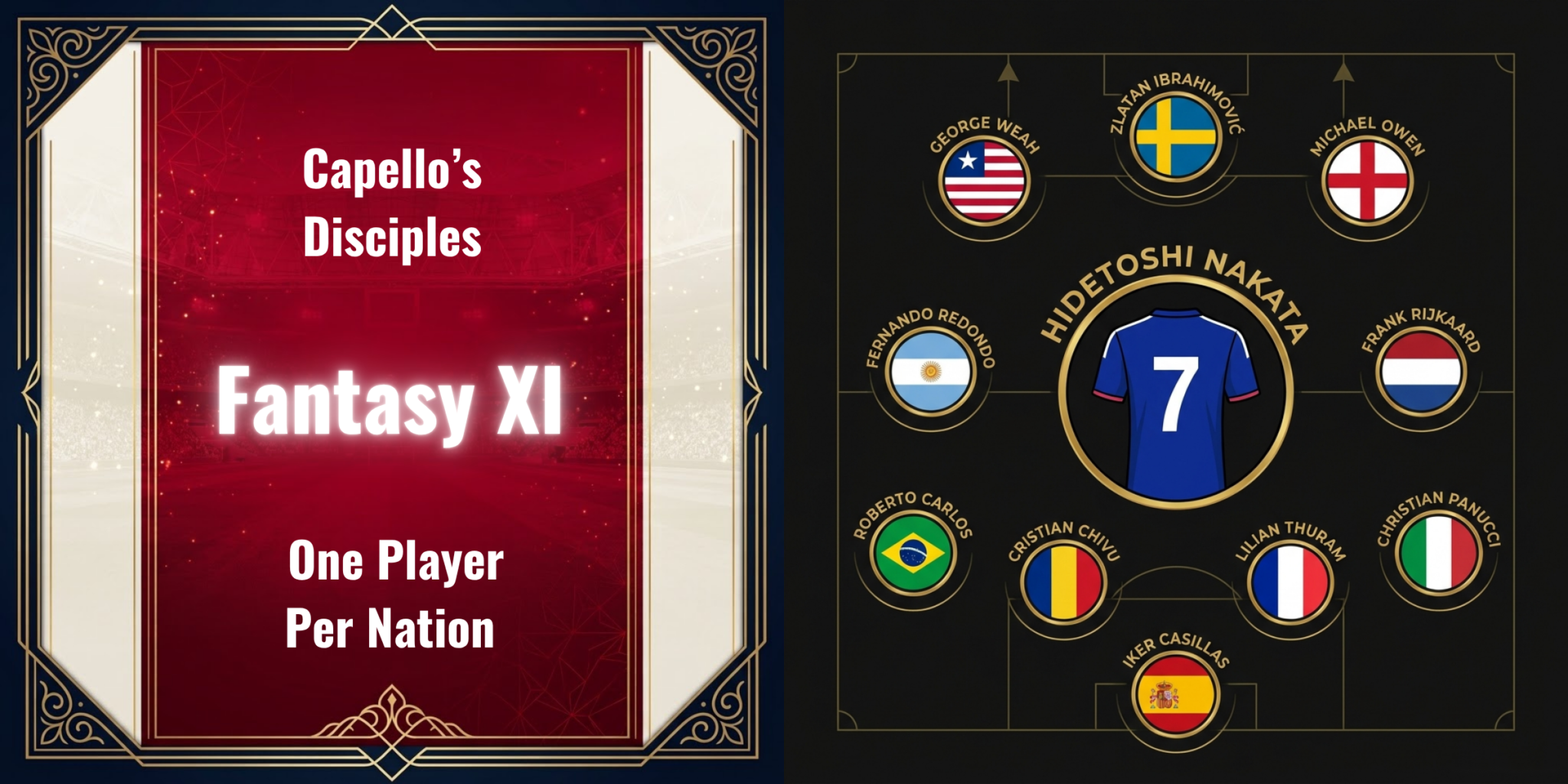
The tactical scenario we are dissecting today is none other than Fantasy XI | Capello’s Disciples Built Around Hidetoshi Nakata!
To construct this dream lineup, three baseline rules must first be respected:
📌 Standard Selection Criteria:
- The player must have been active between 1993 and 2006—the era that sparked my deepest obsession with world football in the wake of the “Agony of Doha.”
- The selection must strictly align with the theme: managed directly by Fabio Capello at any point in their career.
- Every pick must be a recognized legend of world football.
However, to elevate this tactical thought experiment beyond ordinary fantasy lineups, I have imposed two uncompromising special constraints:
🔥 Special Constraints:
- Constraint 1: Absolute exclusion of Nakata’s former club teammates. (To avoid simply replicating the 2000–01 AS Roma Scudetto-winning side, legends like Francesco Totti and Gabriel Batistuta are strictly ineligible. We are here to witness unfulfilled, hypothetical alchemy.)
- Constraint 2: Exactly one player per nation (11 nations, 11 singular talents). (To prevent the squad from being overwhelmed by Italian defensive stalwarts.)
Selected through pure tactical conviction and subjective obsession, here is the ultimate collective designed to unlock Nakata’s genius.
Let us break down the manager’s profile, player selection, and on-pitch tactical mechanics!
👑 Manager & Team Profile

| Category | Profile / Data | Key Insight |
|---|---|---|
| Manager | Fabio Capello | The uncompromising pragmatist who famously declared: “Collecting three points is the supreme virtue in football.” |
| Major Clubs Managed | AC Milan, Real Madrid, AS Roma, Juventus | A tactical heavyweight who delivered domestic league titles (Scudetti and La Liga crowns) at every major club he managed. |
| Selection Premise | Dozens of world-class disciples across four European giants and the England national team! | Building an ultra-coherent collective around Hidetoshi Nakata, who clinched the decisive turning point of the 2000–01 Scudetto under Capello. |
| Tactical Concept | Ultra-Attacking 4-3-3 (The antithesis of Capello’s conservative reputation) | Absolute defensive balance behind him, granting Nakata total freedom to thread razor-sharp vertical balls into an explosive front three. |
Tactical Context: AC Milan, Real Madrid, AS Roma, Juventus—Fabio Capello has been football’s quintessential architect of pragmatic triumph, guaranteeing silverware across every European giant he commanded.
Looking back across Capello’s spells at AC Milan, Real Madrid, AS Roma, Juventus, and the England national team, the sheer number of world-class icons who played under his command is staggering. With a talent pool that deep, an obvious idea struck me: why not build a Fantasy XI exclusively out of Capello’s disciples?
Then came an even more thrilling thought: why not build the entire team around Hidetoshi Nakata? During their 2000–01 Scudetto-winning campaign at AS Roma, Nakata often shared minutes with club icon Francesco Totti rather than holding down an undisputed starting role—yet he still delivered the decisive turning point of the title race. Giving Nakata complete command as the sole centerpiece of a Capello-coached side felt irresistible.
What if Capello were handed a blank tactical canvas—assembling 11 singular talents from 11 distinct nations who had never shared a pitch with Nakata, strictly engineered to elevate his playmaking intellect to its absolute zenith? The curtain rises on an ultra-attacking dream side that turns Capello’s traditional defensive pragmatism entirely inside out.
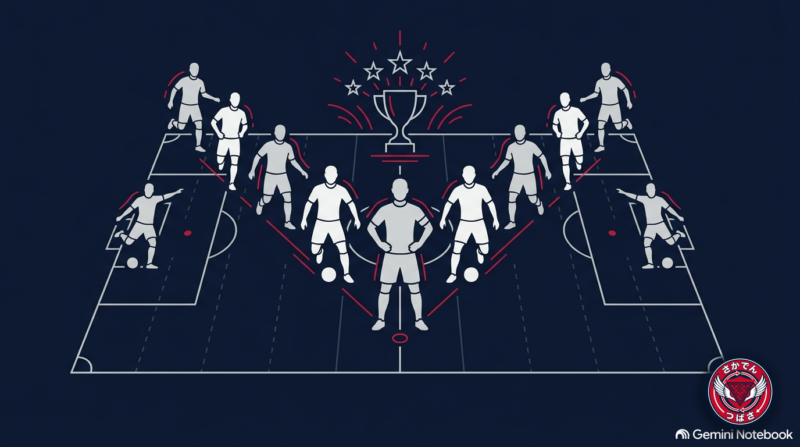
🏆 Capello’s Disciples: The Definitive Starting XI (One Player Per Nation)
⚽ Player Roster & Strategic Roles
Eleven world-class profiles who survived the dual filter of “one player per nation” and “zero shared club minutes with Nakata”:
| Shirt No. | Position | Player | Nation | Archetype & Tactical Profile | Tactical Justification & Rationale |
|---|---|---|---|---|---|
| 1 | GK | Iker Casillas | Spain | The Miracle Reflex: Elite shot-stopping with superhuman reaction speed. | Spain’s solitary spot is used between the posts, allowing outfield slots to be leveraged across other nations—an agonizing sacrifice of Raúl González. |
| 2 | DF | Christian Panucci | Italy | The Tactician’s Ultimate Lieutenant: Capello’s most trusted, tactically disciplined full-back. | Selected ahead of Baresi and Maldini for Italy’s solitary berth—only Capello could unlock 100% of his tactical potential. |
| 21 | DF | Lilian Thuram | France | The Impenetrable Bastion: Tremendous physical acceleration and recovery tackling. | The undisputed first-choice right centre-back, edging out Marcel Desailly and Patrick Vieira for France’s single berth. |
| 13 | DF | Cristian Chivu | Romania | The Left-Footed Architect: Elite ball-playing centre-back with diagonal range. | Romania’s elite representative. Acts as the primary deep distributor, bypassing pressing lines with laser-guided switches. |
| 6 | DF | Roberto Carlos | Brazil | The Bullet Full-Back: Lethal left boot with relentless overlapping stamina. | Brazil’s definitive slot. Hand-picked by Capello at Real Madrid, transforming the left flank into a permanent counter-attacking runway. |
| 4 | MF | Frank Rijkaard | Netherlands | The Black Swan: Supreme physical presence and immaculate first-touch control. | The Dutch anchor. While Seedorf was tempting, engineering a historic, never-before-seen partnership alongside Redondo took absolute precedence. |
| 5 | MF | Fernando Redondo | Argentina | The Supreme Regista: Silky equilibrium, orchestrating the tempo from deep. | Argentina’s single pick. The left-footed deep-lying playmaker who neutralizes incoming pressure and supplies clean service to Nakata. |
| 7 | MF | Hidetoshi Nakata | Japan | The Dynamic Trequartista: Unshakeable core equilibrium and incisive vertical passing. | The absolute focal point. Liberated from tracking back, he can channel every movement into translating his vision into instant damage. |
| 10 | FW | Michael Owen | England | The Lightning Infiltrator: Explosive pace off the shoulder of the last defender. | England’s weapon. Possesses the sheer velocity required to turn Nakata’s demanding, high-risk through balls into golden opportunities. |
| 9 | FW | Zlatan Ibrahimović | Sweden | The Acrobatic Goliath: Towering aerial dominance fused with street-smart technique. | Sweden’s giant. Transforms Nakata’s direct, driven balls into goals through sheer physical insolence and acrobatic improvisation. |
| 14 | FW | George Weah | Liberia | The Kinetic Freight Train: Relentless solo ball-carrying power in transition. | Liberia’s Ballon d’Or icon. Capable of driving 60 yards in transition from a single line-breaking delivery, destroying backlines unassisted. |
😭 The Heartbreaking Omissions
Due to the iron laws of “one player per nation” and “the exclusion of Nakata’s former club teammates,” these world-class titans had to be left behind—a list of omissions so stacked you could build a UEFA Champions League-winning core around them alone:
| Player | Position | Nation | Strategic Reason for Omission |
|---|---|---|---|
| Francesco Totti | FW / AM | Italy | Ineligible due to the teammate rule; the Roma captain shared the pitch with Nakata during the 2000–01 campaign. |
| Gabriel Batistuta | ST | Argentina | Ineligible due to the teammate rule; Nakata’s primary target at Roma. Argentina’s single slot was assigned to Fernando Redondo. |
| Franco Baresi | CB | Italy | Cruelly left out because Italy’s solitary berth was reserved for Capello’s ultimate tactical lieutenant, Christian Panucci. |
| Paolo Maldini | LB / CB | Italy | Missed out for the exact same structural reason as Baresi: the strict one-player-per-nation ceiling. |
| Clarence Seedorf | MF | Netherlands | A personal favorite, yet sacrificed to make room for a mythical, unplayed midfield double pivot of Redondo and Rijkaard. |
| Raúl González | ST | Spain | Ineligible due to the single-nation rule after Spain’s allocation was committed to Iker Casillas in goal. |
⚽ Formation & Tactical Dynamics
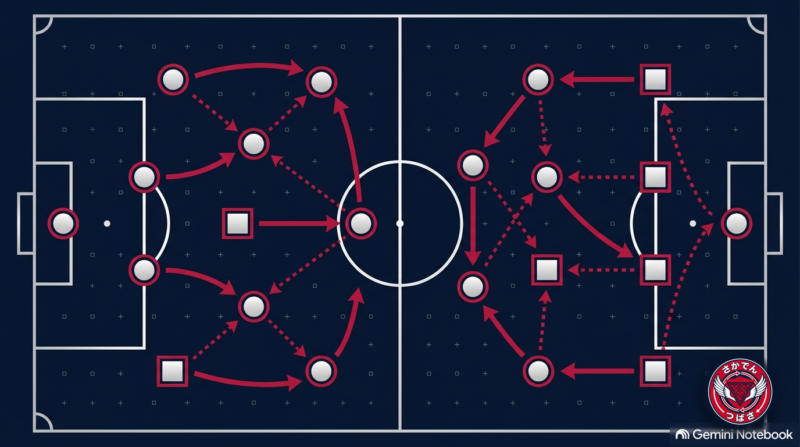
1. The 4-3-3 System (Nakata Installed as the Unfettered Trequartista)
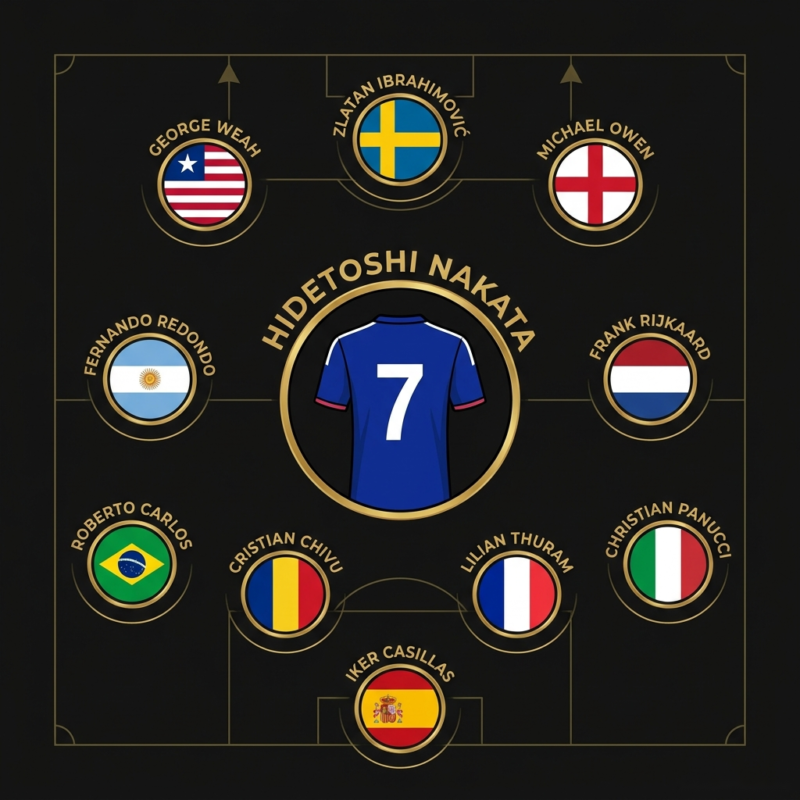
- Goalkeeper (GK): Iker Casillas. Providing an elite safety net behind an aggressive defensive line, neutralizing 1v1 situations with feline reflexes.
- Backline (Back 4): From right to left: Christian Panucci, Lilian Thuram, Cristian Chivu, and Roberto Carlos. Panucci and Thuram form a rock-solid defensive hinge, allowing Roberto Carlos license to bomb forward into the attacking third.
- Double Pivot (Holding Midfield): Fernando Redondo on the left, Frank Rijkaard on the right. Arguably the most complete, aesthetically immaculate deep-lying midfield shield ever conceived in football history.
- Attacking Midfield (No. 10 / Trequartista): Hidetoshi Nakata (No. 7). Stationed between the lines in Zone 14, dictating the entire tempo and trajectory of penetration.
- Front Three (Attack): George Weah off the left wing, Zlatan Ibrahimović occupying the central defenders, and Michael Owen making explosive diagonal runs from the right channel.
2. Tactical Mechanics: Structural Rest-Defense Unleashing Nakata’s Killer Balls
Fabio Capello’s managerial identity has long been associated with Catenaccio-infused realism—the archetypal clinical 1–0 (uno-zero) victory. However, this collective is engineered as an explosive, multi-lane attacking powerhouse.
Crucially, this attacking flair is not built on reckless abandon. The lethal frontline can operate at 120% capacity precisely because the rest-defense structure behind them is virtually unbreakable.
🛡 Defensive Transitions: Asymmetric Rest-Defense and Positional Insurance
The double pivot of Frank Rijkaard and Fernando Redondo, flanked by the disciplined Christian Panucci at right-back, represents the purest manifestation of Capello’s tactical rigor.
Whenever Roberto Carlos surges upfield or Lilian Thuram steps aggressively out of the line to intercept, this trio executes seamless positional cover—Panucci tucking inside to form a back three while Rijkaard and Redondo screen the half-spaces and sweep up second balls. Counter-attacking corridors are choked off before the opposition can even lift their heads.
🪄 Offensive Dynamics: Turning “Killer Balls” into “Angels’ Deliveries”
Endowed with an immovable physical core, Hidetoshi Nakata could absorb violent challenges from behind without his upper body flinching, keeping his hips aligned to face forward. The moment he swivels between the lines in Zone 14, the opposition’s defensive block faces checkmate.
It must be emphasized: this front three was not assembled merely to fulfill passport criteria.
The truth is the exact inverse: Only these three singular profiles possessed the rare physical and technical traits capable of multiplying Nakata’s playmaking imagination.
Nakata’s trademark passing style was famously demanding. He did not deliver comfortable, rolling balls to feet; he fired aggressive, high-velocity vertical balls into vacant space—demanding that his runners sprint at maximum intensity, cushion the ball at top speed, and finish clinically. Average strikers would despair, unable to match the frequency or velocity of his passes.
Yet when met with three generational athletes boasting sonic acceleration, acrobatic aerial dominance, and unstoppable transition running, those demanding “killer balls” suddenly transform into devastating “angels’ deliveries.”
| Attacking Phase | Tactical Trigger & Execution | Resulting Goal Mechanism |
|---|---|---|
| ① Infiltration into the Channels | Nakata delays on the ball, drawing out markers before threading a disguised through ball into the inside-right channel. | Michael Owen bursts behind the defensive line at supersonic speed, clipping a first-time finish across the goalkeeper. |
| ② Central Link-up in Zone 14 | Nakata absorbs contact from an opposing defensive midfielder, drilling a vertical pass directly into the striker’s chest. | Zlatan Ibrahimović cushions the delivery under immense pressure, spinning to execute an audacious acrobatic volley into the top corner. |
| ③ High-Speed Transition & Counter-Attack | Nakata splits the transitioning defense with a single, razor-sharp pass into open space down the left. | George Weah—”the Liberian Phenomenon”—latches onto the delivery at blistering speed, leaving defenders behind to finish off a 50-yard breakaway. |
Just as Hiroshi Nanami once provided tactical equilibrium behind him in the Japanese national team, Nakata is shielded here by the left-footed genius of Redondo and the all-conquering authority of Rijkaard. Liberated from grinding defensive burdens, Nakata can pour 100% of his cognitive bandwidth and technical audacity into cutting defensive structures to ribbons.
💭 Conclusion: Capello’s Pragmatism Meets Nakata’s Unshackled Romance
Deploying Capello’s most trusted soldier, Christian Panucci, over legends like Baresi and Maldini; navigating the rigid constraints of one player per nation; and categorically omitting Nakata’s former club teammates—this lineup began as an exercise in constraint, but culminated in pure tactical harmony.
Throughout his storied career, Hidetoshi Nakata shouldered an immense burden of defensive running. Whether steering the Japanese national team or competing at top Serie A clubs, he was routinely expected to be the hardest worker: tracking runners, putting his body on the line in gritty duels, and then creating moments of genius in attack. Perhaps only during his early breakthroughs at Bellmare Hiratsuka or AC Perugia was he ever truly granted pure offensive freedom.
That historical reality makes this fantasy setup intensely cathartic.
Fabio Capello, football’s ultimate pragmatist who prioritized victory above all else, lays down an impenetrable defensive bedrock featuring Rijkaard, Redondo, and Panucci, and issues one simple directive: “Hidé, leave the defensive labor to the men behind you. Keep your eyes forward, and paint your wildest ideas across the pitch.”
With an unshakeable structural foundation beneath his feet, Nakata’s sharp, incisive passes are unleashed. Owen races onto them at blistering pace, Ibrahimović bullies defenders into submission with acrobatic audacity, and Weah tears through entire backlines.
The ruthless organization of Fabio Capello intersecting with the unfettered brilliance of iconic mavericks. This is the ultimate romance of building a historical Fantasy XI!
If you were granted access to the vast catalog of Capello’s former disciples, what kind of “one player per nation” Fantasy XI would you build?
Looking for more tactical breakdowns?
Beyond these Fantasy XI lineups, I also publish deep-dive tactical profiles focused on individual football legends:
👉 Johan Cruyff | Space, Geometry, and the Architect Who Rebuilt Modern Football