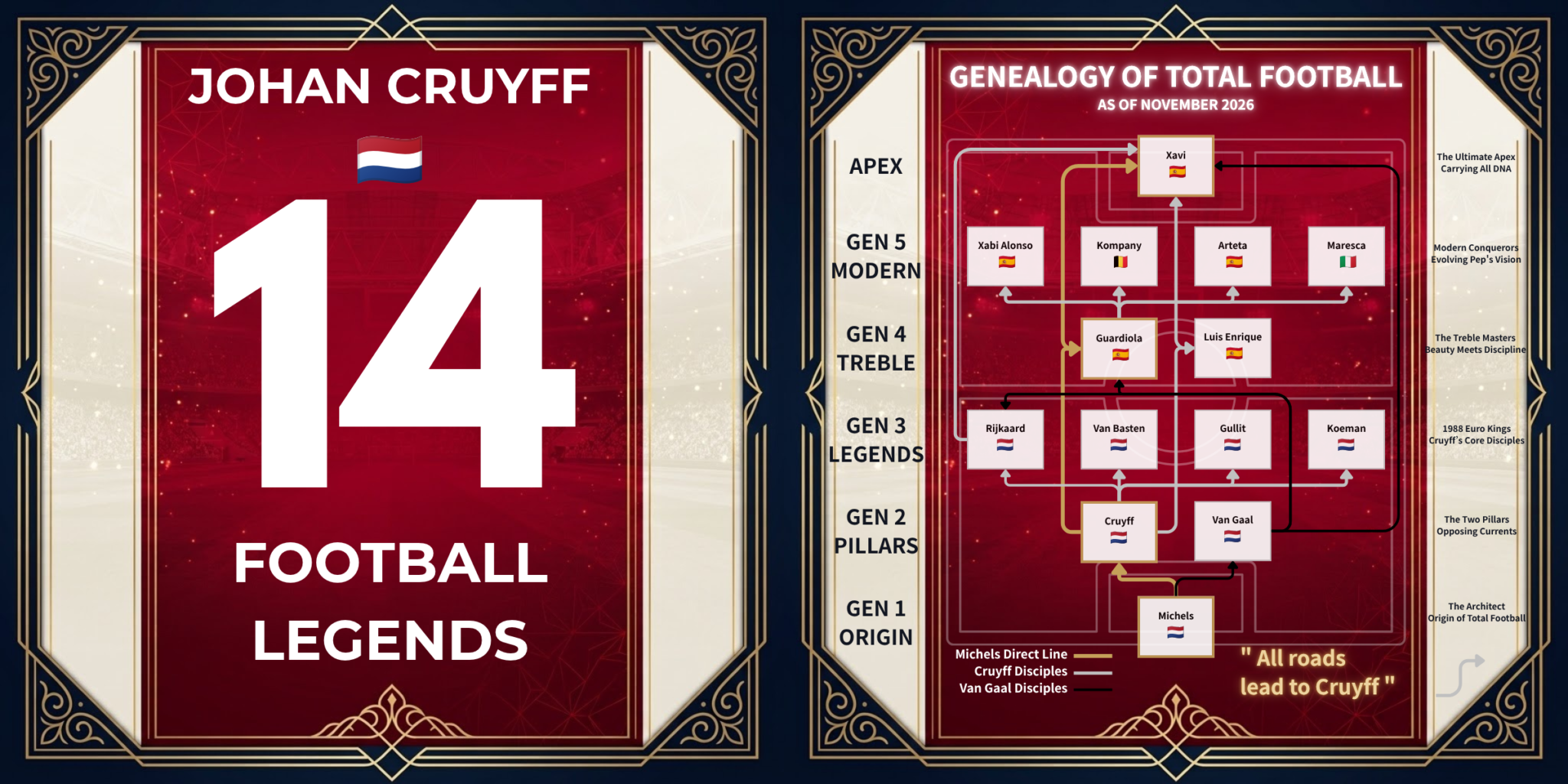
Welcome back—Jonoren here.
The legendary football icon we are dissecting today is none other than Johan Cruyff!
The thinker who geometrically dominated space: “Cruyff didn’t just occupy space; he made the pitch pay rent for his intellect.”
He never lifted the World Cup, appearing on that grand stage only once in 1974. Yet, alongside Pelé and Diego Maradona, he remains revered by football purists worldwide as one of the holy triumvirate in the history of the game.
As a player, he embodied Total Football, claiming three Ballon d’Or awards. As a visionary manager, he constructed the immortal El Dream Team at FC Barcelona, drafting the structural blueprint that modern football still operates on today.
Driven by my lifelong passion for Ajax and grounded in a forensic analysis of his handwritten movement trajectories from the 1974 World Cup Final, I invite you to unpack the profound genius of this footballing prophet.
🤝 My Encounter with Cruyff: Jun Misugi, Captain Tsubasa, and the Electric Shock of No. 14
My earliest consciousness of Johan Cruyff arrived through the pages of the legendary manga Captain Tsubasa, which captivated my childhood.
The “Prince of the Pitch,” Jun Misugi—captain of Musashi FC—wore the number 14. When I later discovered that this number was chosen out of ultimate reverence for Johan Cruyff, my curiosity was ignited.
Total Football, the Cruyff Turn, the Flying Dutchman, the Clockwork Orange… As I fell deeper in love with the game, every captivating phrase in football seemed to trace its lineage back to this single Dutch maestro. Yet at the time, he remained a distant symbol of legend to me.
The turning point came in the 1994–95 season. Watching Louis van Gaal’s youthful AFC Ajax conquer Europe with breathtaking football, I pledged lifelong devotion to the club. However, the deeper I delved into Ajax’s history, the more I confronted an inescapable truth: the academy blueprint, the tactical philosophy, even the club’s pride in “winning with beauty”—every single thread traced back to Johan Cruyff. The more I learned, the more my admiration evolved into something closer to awe.
Years later, watching archival broadcasts of the full 1974 World Cup Final between the Netherlands and West Germany, I was left completely spellbound.
“Why is a registered centre-forward dropping all the way back into the holding midfield pivot, furiously orchestrating teammates with both hands?”
“He doesn’t possess blistering linear sprint speed, so why do elite defenders freeze like statues as he glides past them like an eel?”
The moment I witnessed that surreal presence, a pleasant chill ran down my spine. What kind of pitch was this man seeing inside his head?
He surveyed the game like an omniscient chess grandmaster, manipulating both teammates and adversaries at will, only to surge into the vacated zone at the exact microsecond to apply the clinical finish.
To touch the depths of that extraordinary mind, let us begin by laying out his definitive profile.
- Profile
- Playing Style
- Tactical Parameter Evaluation
- Club Career Highlights: The Ajax Three-Peat and the Savior of Barcelona
- International Career: The 1974 World Cup and the Art of the Beautiful Loser
- Managerial Masterclass: The Genesis of the Dream Team and Modern Football
- The Ajax Laboratory: Promoting Youth, Discovering Bergkamp, and Ending a 14-Year European Drought
- Barcelona’s “El Dream Team” and Four Consecutive La Liga Titles: Evolving Total Football Against the Age of Catenaccio
- Passing the Cruyffian Gene to Pep and the World: Building the Cathedral and Perfecting the “False Nine”
- The Rebel Aesthetics: Shirt No. 14, Two Stripes, and Smoking
- Conclusion: The “Predictive AI” Johan Cruyff Unveiled Half a Century Ago
Profile

| Category | Career Details |
|---|---|
| ① Player Name | Johan Cruyff (Hendrik Johannes Cruijff) |
| ② Nationality (& Region) | Netherlands (Amsterdam, Betondorp) |
| ③ Born / Died | April 25, 1947 – March 24, 2016 (Aged 68) |
| ④ Height | 178 cm (5 ft 10 in) |
| ⑤ Weight | 67 kg (148 lbs) |
| ⑥ Preferred Foot | Right (Flawless precision with both feet) |
| ⑦ Primary Roles | Centre-Forward / Deep-Lying Playmaker (Regista) / Left Winger |
| ⑧ Domestic League Career | ・1964–1973: AFC Ajax (239 apps, 190 goals) ・1973–1978: FC Barcelona (143 apps, 48 goals) ・1979: Los Angeles Aztecs (27 apps, 14 goals) ・1980–1981: Washington Diplomats (32 apps, 12 goals) ・1981: Levante UD (10 apps, 2 goals) ・1981–1983: AFC Ajax (36 apps, 14 goals) ・1983–1984: Feyenoord (33 apps, 11 goals) Domestic League Total: 520 apps, 291 goals (0.56 goals/game) Total Official Career: 704 apps, 389 goals (0.55 goals/game) |
| ⑨ International Career | Netherlands: 48 caps, 33 goals (0.69 goals/game) |
| ⑩ World Cup Record | 1974 West Germany (Runners-up, Golden Ball / Tournament MVP; 7 apps, 3 goals) |
| ⑪ Iconic Shirt Numbers | Club: No. 14 (Retired by Ajax), No. 9 (Barcelona), No. 10 (Feyenoord) Country: No. 14 (Netherlands) |
Playing Style
Cruyff’s style of play can be summarized in one definition: “The ultimate on-pitch commander who dominated the geometry of the pitch by shifting the opponent’s gravity and carving out space.”
Beyond his supreme technical palette and composure in front of goal, his most devastating weapon was perpetual on-pitch coaching and predictive spatial awareness. Studying the 1974 World Cup footage reveals that Cruyff’s hands never stopped moving. His right arm pointed teammates toward vacant half-spaces, his left dictated passing lanes, and both arms extended to adjust the defensive block’s compactness. It was the physical manifestation of the panoramic “bird’s-eye vision” made famous by the protagonist Aoi Ashito in the manga Aoashi.
His execution of the foundational first touch and distribution was flawless. Alternating between the inside and outside of both feet with millimetric precision, he fed crisp ground passes through the opposition’s defensive lines or clipped delicate chips into the channels behind them.
And then, his iconic signature: the dribble. While the Cruyff Turn—feigning a cross before dragging the ball 180 degrees behind the standing leg—is universally celebrated, its core mechanism lies in manipulating the defender’s kinetic equilibrium. Cruyff would wait for the defender to fully commit their weight onto the front knee. The instant the defender planted their foot and their momentum was locked, Cruyff would execute a feather-light deceleration, drop his hips, and burst in the opposite direction. To opponents, his sudden shifts in tempo made him appear to accelerate at double speed, earning him his reputation in Dutch football as an uncatchable “eel.”
What is even more startling is his extraordinary goal-scoring efficiency. Cruyff netted 33 goals in 48 caps for the Netherlands (a strike rate of roughly 69%). Despite rarely taking penalties due to his philosophical view on pressure and shooting mechanics, his international scoring ratio easily eclipsed the greatest Dutch pure strikers who followed him:
📊 Comparative Scoring Efficiency (Netherlands National Team)
| Striker | International Record | Goals per Match |
|---|---|---|
| Johan Cruyff | 48 caps, 33 goals | ~0.69 |
| Patrick Kluivert | 79 caps, 40 goals | ~0.51 |
| Ruud van Nistelrooy | 70 caps, 35 goals | 0.50 |
| Robin van Persie | 102 caps, 50 goals | ~0.49 |
| Dennis Bergkamp | 79 caps, 37 goals | ~0.47 |
| Marco van Basten | 58 caps, 24 goals | ~0.41 |
Cruyff did not camp inside the penalty area waiting for service. Instead, he manipulated the positioning of 21 other men so that, by the time the sequence concluded, the most dangerous zone was left completely open for his own arrival. He was a singular anomaly in the history of the sport.
Tactical Parameter Evaluation

| Attribute | Rating | Tactical Breakdown |
|---|---|---|
| Attacking | ★★★★★ (5/5) | An international strike rate of ~69%; the composure to orchestrate from deep and finish clinically. |
| Defending | ★★★☆☆ (3/5) | Triggering the high press from the front; dropping into the pivot to cover transitional gaps. |
| Technique | ★★★★★ (5/5) | The Cruyff Turn; supreme cushioning, two-footed range, and immaculate first-touch mechanics. |
| Pace / Deceleration | ★★★★★ (5/5) | Deceptive top speed combined with devastating hip mobility and change of pace against committed defenders. |
| Physicality / Core | ★★★★☆ (4/5) | Slender at 178 cm and 67 kg, yet possessing remarkable dynamic balance that rode crunching challenges. |
Note: Ratings represent an independent tactical evaluation on a 5-point scale.
Attacking 5, Technique 5, Pace 5.
Gliding over desperate sliding tackles with effortless poise and governing the tempo of entire matches, Cruyff became the first player in history to win three Ballon d’Or awards (1971, 1973, 1974)—an enduring testament to his supremacy.
Club Career Highlights: The Ajax Three-Peat and the Savior of Barcelona
The Ajax Dynasty: Three Consecutive European Cups and De Mistwedstrijd
Cruyff’s journey began in Betondorp, a working-class neighbourhood in eastern Amsterdam. Growing up literally across the road from Ajax’s De Meer Stadion, he joined the youth academy at age 10, honing his vision and street-smart instincts on the cobblestones. After his father passed away when Johan was just 12—and his mother took a job as a cleaner at the ground—he became the club’s informal mascot.
Shortly after Cruyff made his senior debut at 17 in 1964, his destiny intertwined with the legendary Rinus Michels, who took the helm in 1965. Together, they dissolved rigid positional structures and engineered Total Football. Cruyff was the sole conductor capable of translating Michels’ revolutionary geometry onto the grass.
The continent first truly bowed to Cruyff on December 7, 1966, during the European Cup second round against Bill Shankly’s English champions, Liverpool. In a match shrouded in dense Dutch fog—forever remembered as De Mistwedstrijd (The Fog Match)—the 19-year-old Cruyff dismantled Liverpool’s vaunted backline in a 5–1 rout, following it up with a brace in a 2–2 draw at Anfield.
From 1971 to 1973, Ajax ruled Europe with an iron fist. They captured three successive European Cups: defeating Panathinaikos 2–0 in 1971, crushing Inter Milan’s Catenaccio 2–0 in 1972 (Cruyff scoring both), and dispatching Juventus 1–0 in 1973. Through seamless rotational mechanics and territorial dominance, Cruyff transformed a modest Dutch side into an immortal powerhouse.
The Savior of Barcelona and the 5–0 Masterclass at the Bernabéu
In the summer of 1973, Cruyff moved to FC Barcelona for a world-record fee of 6 million guilders (approx. $2 million). Reunited with Michels in Catalonia, Cruyff entered a theater that transcended sport.
Spain was suffocating under the Franco dictatorship, which systematically suppressed Catalan identity, language, and culture. In this tense climate, FC Barcelona was the ultimate symbol of regional pride and resistance (Més que un club). In Cruyff—a defiant, outspoken iconoclast—the Catalans discovered their savior (El Salvador).
The watershed moment arrived on February 17, 1974, in El Clásico at the Santiago Bernabéu. In hostile territory, Cruyff dismantled Real Madrid with surgical precision. Orchestrating lightning pass-and-move combinations, Cruyff inspired Barcelona to humiliate their bitter rivals 5–0. As the Bernabéu crowd watched in stunned silence, citizens poured into the streets of Barcelona in tears of catharsis.
Cruyff propelled Barça to their first La Liga championship in 14 years, collecting his historic third Ballon d’Or in 1974. He did not merely win silverware; he restored an entire culture’s dignity.
The Feyenoord Vendetta: A Masterclass in Spite at Age 36
After adventures in North America’s NASL, Cruyff returned to Ajax in December 1981 at age 34, immediately leading them to back-to-back league titles. However, in the summer of 1983, Ajax president Ton Harmsen bluntly declared that Cruyff was “too old” and refused him a contract renewal.
Furious at this disrespect, Cruyff executed the ultimate act of defiance: he signed for Ajax’s fiercest arch-rivals, Feyenoord.
Early in the 1983–84 campaign, Feyenoord suffered a humiliating 8–2 defeat away at Ajax. Critics gleefully penned Cruyff’s football obituary. Yet Cruyff remained unfazed, shifting his game entirely from personal running to tactical positioning—adjusting his teammates’ angles by two meters with furious hand gestures. Mentoring a 21-year-old prodigy named Ruud Gullit, Cruyff elevated the team’s tactical IQ.
When Ajax visited De Kuip on February 26, 1984, Feyenoord exacted sweet revenge with a commanding 4–1 victory. Cruyff steered Feyenoord to their first Eredivisie title in a decade—completing a historic domestic double—won Dutch Footballer of the Year at 37, and retired on his own terms having thoroughly humiliated the boardroom that wrote him off.
International Career: The 1974 World Cup and the Art of the Beautiful Loser

For the Oranje, Cruyff amassed 48 caps and 33 goals. Yet his eternal monument was built across seven matches in the summer of 1974 in West Germany.
Dressed in vibrant orange and dubbed the Clockwork Orange, the Dutch stunned the globe with synchronized high pressing, interchanging positions, and aggressive offside traps. They blew away Argentina 4–0 and dismantled reigning champions Brazil 2–0, with Cruyff sealing victory via a breathtaking horizontal airborne volley at the back post—a gravity-defying strike that cemented his immortal nickname, the Flying Dutchman.
What Pitch Trajectories Reveal About the 1974 Final: Dissecting Cruyff’s Handwritten Footprints Against West Germany
July 7, 1974—Munich’s Olympiastadion.
Standing across from the Netherlands in the World Cup Final were the tournament hosts, West Germany, marshaled by Der Kaiser Franz Beckenbauer at the absolute peak of his powers.
Archival footage from that era was filmed in the narrow, ball-following frame of vintage CRT television broadcasts. Without modern wide-angle tactical cameras, the entire pitch is rarely visible at once.
So I decided to lock my eyes exclusively onto one man—Johan Cruyff—whenever he entered the frame, putting pen to paper to manually trace every single movement and footprint across the grass.
What emerged on that blank sheet of paper was an astonishing map of tactical thought—one that outstrips even modern football theory.
(Note: Because shirt numbers are barely legible in the grainy 1974 broadcast footage, this is a purely analog observational sketch traced manually by tracking Cruyff’s unmistakable long hair, silhouette, and distinctive stride.)
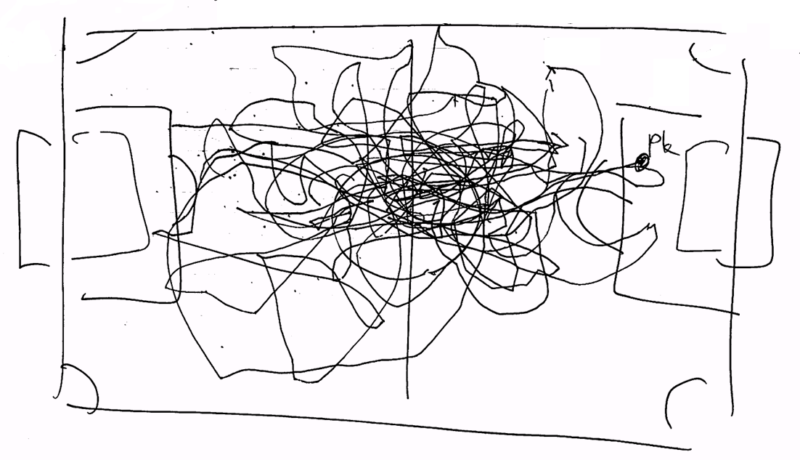
First Half (Netherlands Attacking Direction ➡ Right)
Despite being listed on the team sheet as a centre-forward, the densest cluster of ink on my pitch map was not inside the German penalty area—it radiated outward from the centre circle, stretching evenly from deep inside the Dutch half all the way to the front line.
The standout sequence, of course, was winning the opening penalty within the very first minute. Without allowing a single West German player to touch the ball, the Netherlands strung together 16 uninterrupted passes before Cruyff himself sliced straight through the center on the dribble to draw the foul. Johan Neeskens buried the spot-kick for a lightning-fast 1–0 lead. As noted in his playing style, this goal would have been impossible without Cruyff calculating and manipulating the center of gravity of both teammates and opponents in reverse—all to carve out the exact pocket of space where he wanted to strike.
What astonished me even further during my observation was watching Cruyff jog over to take throw-ins himself.
Why would a team’s focal point in attack walk all the way to the touchline to collect the ball and throw it back into play?
It was almost certainly another cold, calculated decoy. By pulling himself out to the wide touchline, he dragged his central markers toward the perimeter, leaving a cavernous pocket of space wide open in the central danger zone for his teammates to exploit.
Yet what truly kept my pen racing across the page was the constant movement of his hands.
On the pitch, Cruyff was pointing almost continuously. While the broadcast audio could not pick up his voice, he barked instructions without pause, frequently stretching both arms wide to adjust the entire team’s shape. The spaces about to open up were simply too vivid inside his mind—a real-life manifestation of the panoramic “bird’s-eye vision” made famous by Ashito Aoi in the manga Aoashi.
Still, buoyed by ferocious home support, West Germany refused to fold. After equalizing from the penalty spot in the 25th minute to make it 1–1, clinical poacher Gerd Müller spun and tucked away a scrappy finish in the 43rd minute, sending the Netherlands into the half-time interval trailing 1–2.
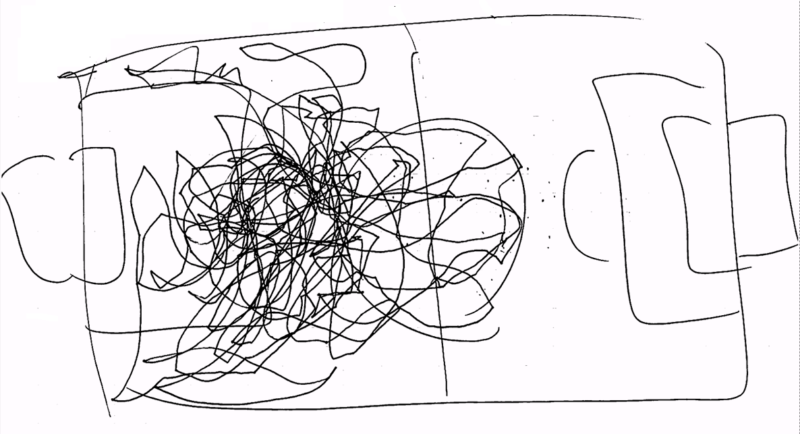
Second Half (Netherlands Attacking Direction ⬅ Left)
When the second half kicked off, the ink on my paper began to sketch an entirely different landscape.
While he may have occasionally dropped deeper during moments off-camera, Cruyff stationed himself almost exclusively inside the attacking half beyond the centre circle, relentlessly conducting the Dutch pursuit.
What the Handwritten Trajectories Reveal About Cruyff:
- First Half — Orchestrating from the Centre Circle: Immediately after taking the early lead, Cruyff shuttled evenly between his own half and the front line around the centre circle, dictating the match’s tempo and distribution from the heart of the pitch.
- Second Half — Relentless Incursions into the Final Third: Chasing a one-goal deficit, he camped almost permanently beyond the centre circle, repeatedly probing the pocket between the lines and driving into the German penalty area.
- Neutralizing Tight Marking with a Single Feint: Despite enduring tenacious, shadow-like man-marking from West Germany’s Berti Vogts, Cruyff toyed with him—using a sharp cutback or a deft first-time flick the split second before Vogts could make physical contact.
- Selfless Decoy Runs to Carve Out Space: By drifting wide to take throw-ins himself, he dragged central defenders toward the touchline, vacating dangerous central pockets for teammates to surge into.
- Perpetual Hand-Gestured Coaching: Even inside congested zones, he never stopped pointing into open spaces with his right hand or stretching both arms wide, manipulating the geometry of both teams until the very end.
Despite mounting a furious onslaught, the Netherlands were thwarted by West Germany’s resolute defending and the heroics of goalkeeper Sepp Maier. Unable to find that elusive second goal, the Dutch saw the final whistle blow at 1–2.
On the scoreboard, they were beaten, and it was West Germany who lifted the trophy (seen through Franz Beckenbauer’s eyes, it would surely read as a completely different tale of tactical perfection). Yet in my hands—having tracked his every step with a single pen—remained the undeniable proof that one man had held total command over the pitch’s time and space.
Half a century ago, flickering across a vintage CRT screen, Johan Cruyff was already embodying the entirety of modern football.
Managerial Masterclass: The Genesis of the Dream Team and Modern Football

The primary reason Johan Cruyff stands as a truly singular figure in football history is that he did not merely reach the pinnacle of the game as a player—he also completely rebuilt its tactical architecture as a manager.
Transplanting the philosophy of Total Football—which he had once embodied on the grass—from the dugout across the entire pitch, the very first laboratory for this grand experiment was his boyhood club, Ajax.
The Ajax Laboratory: Promoting Youth, Discovering Bergkamp, and Ending a 14-Year European Drought
In 1985, just one year after hanging up his boots, Cruyff returned to the dugout of his beloved AFC Ajax. Because he did not yet hold a formal coaching license, his official title was “Technical Director”—yet his ambition extended far beyond merely winning matches with the first team. He launched a club-wide structural revolution, instilling the exact same tactical blueprint and philosophy from the youngest academy tiers all the way up to the senior squad.
Onto the pitch, Cruyff introduced a radical 3-4-3 system featuring a midfield diamond that stretched the full width of the grass. Anchoring his side around mature, world-class pillars—prolific striker Marco van Basten up front and Frank Rijkaard at the base of midfield—Cruyff fearlessly promoted raw diamonds from Ajax’s famed youth academy.
The ultimate symbol of this youth movement was a 17-year-old prospect named Dennis Bergkamp. Recognizing an extraordinary gift in the teenager’s first touch and panoramic spatial awareness, Cruyff handed Bergkamp a surprise senior debut against Roda JC on December 14, 1986. The creative virtuoso who would later mesmerize the world at Arsenal with his divine first touch was first unearthed by Cruyff’s unmatched eye for talent.
This brand of attacking football quickly bore tangible silverware. Advancing to the 1986–87 UEFA Cup Winners’ Cup Final in Athens on May 13, 1987, Ajax faced East Germany’s 1. FC Lokomotive Leipzig, holding firm to preserve a 1–0 victory courtesy of a Marco van Basten header. It ended a 14-season European trophy drought for Ajax—stretching all the way back to the 1972–73 campaign, when Cruyff himself had captained the club to three consecutive European Cups as a player.
Promote youth, drill a singular philosophy, and conquer through breathtaking spectacle. The tactical laboratory Cruyff perfected in Amsterdam would soon serve as the grand prototype for the immortal El Dream Team that was about to bloom in Catalonia.
Barcelona’s “El Dream Team” and Four Consecutive La Liga Titles: Evolving Total Football Against the Age of Catenaccio
European football in that era was indisputably the golden age of Italy’s Serie A. Across the ten seasons from 1988–89 to 1997–98, Italian clubs reached the European Cup (now Champions League) Final an astonishing nine times. Alongside Italy’s traditional Catenaccio—the proverbial bolt-locked defensive system—Arrigo Sacchi’s high-intensity zonal pressing at AC Milan was sweeping across the continent.
While managers worldwide agonized over how to crack those suffocating defensive blocks, SSC Napoli wrestled away the Scudetto through the sheer force of Diego Maradona—a singular phenomenon capable of dismantling tactical systems all by himself. Yet Johan Cruyff’s answer was never to rely on individual destruction. Instead, he evolved the Total Football he had once embodied on the grass into an ultra-attacking collective that asphyxiated opponents through geometric positioning—giving birth to FC Barcelona’s immortal El Dream Team.
On the pitch, Cruyff’s blueprint revolved around stretching defensive blocks horizontally from touchline to touchline. He revived the dying art of traditional wingers, pinning them wide against both sidelines, while promoting a 20-year-old graduate of La Masia—Pep Guardiola—into what we would now call a regista (deep-lying playmaker) at the base of midfield. With Ronald Koeman launching laser-guided long passes from the back, Guardiola orchestrating from the pivot, and Michael Laudrup threading defense-splitting through balls into dangerous pockets, Cruyff forged an unshakeable central spine.
Up front, he assembled firepower of staggering destructive force: Bulgaria’s lethal marksman Hristo Stoichkov and, arriving in 1993, Brazil’s prodigal goalscoring genius Romário. While both possessed otherworldly instincts in front of goal, they were also notoriously volatile firebrands whose tempers frequently sparked turmoil on and off the pitch. Yet Cruyff seamlessly integrated these two untamed forces of nature into a Total Football machine governed by the absolute law of collective attack and collective defense, unleashing their devastating scoring output. Turning fiercely ego-driven superstars into disciplined cogs within a collective system served as paradoxical proof of Cruyff’s supreme authority and magnetism.
Under the regulations of the time, only a maximum of three foreign players were permitted on the pitch at once. While domestic La Liga rules allowed a manager to keep a fourth foreigner on the bench as a substitute, the European Champions League enforced an even stricter limit: a maximum of three foreign players in the entire matchday squad, bench included.
Here is the iconic, world-class quartet of the Dream Team that gave Cruyff such a glorious selection headache under UEFA’s three-foreigner limit:
- Ronald Koeman: The defensive linchpin who unleashed devastating long-range cannonballs from the back.
- Michael Laudrup: The wizard of dribbling and defense-splitting through balls who constantly manipulated opponents’ center of gravity.
- Hristo Stoichkov: The Bulgarian powerhouse who bludgeoned defenses open with explosive pace and ferocious competitive fire.
- Romário: The solitary, ice-cold assassin who ruthlessly piled up goals inside the penalty box.
Out of these four world-class icons—Koeman, Laudrup, Stoichkov, and Romário—Cruyff was forced to relegate one superstar not merely to the bench, but to watching from the stands on every major European night. This luxurious dilemma and the friction caused by constant rotation would eventually sow the seeds of Laudrup’s departure and his shocking transfer to bitter arch-rivals Real Madrid.
Yet, even while navigating such fierce internal tensions, Barcelona exerted absolute dominance domestically, capturing four consecutive La Liga titles starting from the 1990–91 campaign.
Their crowning glory arrived on May 20, 1992, in the European Cup Final at London’s original Wembley Stadium. Facing a formidable Italian side in UC Sampdoria, the deadlock remained unbroken at 0–0 deep into extra time. Then, in the 111th minute, Koeman stepped up to a direct free-kick just outside the penalty area and unleashed a thunderous strike with his right boot. The bullet-like low drive arrowed into the bottom-right corner to seal a 1–0 victory—delivering Barcelona their first-ever European Cup (“Big Ears”) in the 93rd year since the club’s founding.
Before kickoff, inside a dressing room thick with suffocating pressure, Cruyff delivered five words to his players that remain immortalized as the ultimate footballing philosophy:
“Go out and enjoy yourselves” (Salid y disfrutad).
In an era ruled by rigid defensive pragmatism and physical attrition, El Dream Team proved to the world the sheer joy of winning through attacking beauty. It was the supreme work of art left behind by Johan Cruyff, a thinker without equal.
Passing the Cruyffian Gene to Pep and the World: Building the Cathedral and Perfecting the “False Nine”
“If you have the ball, the opposition can’t score.”
“Playing football is very simple, but playing simple football is the hardest thing there is.”
The disciple who inherited these immortal maxims in their purest, highest-octane form was Pep Guardiola—the former La Masia youth product whom Cruyff himself had once promoted to the first team.
Years later, Guardiola famously paid tribute to his mentor with these words:
“Johan Cruyff built the cathedral. Those of us who followed as Barcelona managers have merely been repainting or restoring its frescoes.”
Appointed manager of FC Barcelona’s first team in the summer of 2008, Guardiola sharpened Cruyff’s tactical ideology to its absolute cutting edge. He handed control of the midfield to three petite, technically gifted academy graduates—Xavi Hernández, Andrés Iniesta, and Sergio Busquets—while deploying Lionel Messi across the front line. That system detonated with unforgettable brilliance on May 2, 2009, in El Clásico away against Real Madrid at the Santiago Bernabéu.
On that historic night, Guardiola shifted Messi from his customary right-wing berth into the central striker role, instructing him to drop deep into midfield and drag the opposing centre-backs out of position as a “False Nine” (Falso Nueve). Geometrically dismantling Madrid’s backline, Barcelona stormed to a monumental 6–2 victory on enemy turf.
That movement—dropping into the pocket between the lines to open space for teammates—was the exact maneuver Cruyff had executed and pointed out in the 1974 World Cup Final, perfected 35 years later by a generational genius in Messi. That campaign, Barcelona captured the first treble in Spanish football history before completing an unprecedented six-trophy clean sweep (the sextuple) across the calendar year.
The seeds Cruyff planted continued to flourish through Guardiola’s Manchester City, branching out into a new generation of elite European tacticians—including Mikel Arteta at Arsenal, Xabi Alonso at Bayer Leverkusen, and Vincent Kompany at Bayern Munich.
Positional play (Juego de Posición), coordinated high pressing, and building out from the back involving the goalkeeper—when we trace the lineage of every tactical pillar that defines modern football today, all roads inevitably lead back to the mind of one man: Johan Cruyff.
A tactical genius. A revolutionary of the beautiful game.
Yet beneath those grand titles lay a fiercely uncompromising aesthetic and a rebellious spirit that refused to ever walk a path laid down by someone else.
Here are three iconic episodes that vividly capture the true essence of Johan Cruyff the man:
The Rebel Aesthetics: Shirt No. 14, Two Stripes, and Smoking

1. The Vow of No. 14: Making It “Cruyff’s Number”
On October 30, 1970, ahead of an Eredivisie clash against PSV Eindhoven, teammate Gerrie Mühren misplaced his regular No. 9 jersey. Without hesitation, Cruyff—who wore Ajax’s iconic No. 9 at the time—handed his own shirt to Mühren, reached into the kit basket for a spare No. 14 jersey, and stepped onto the pitch. Ajax secured a 1–0 victory, and deciding to keep wearing No. 14 as a good-luck charm, Cruyff famously declared:
“No. 9 belongs to Di Stéfano, and No. 10 belongs to Pelé. I will make No. 14—a number nobody else wears—into ‘Cruyff’s number.'”
In an era when it was virtually unheard of for a star player to wear anything outside the traditional 1-to-11 starting numbers, Cruyff etched “14” into football history forever as the ultimate declaration of his individuality.
2. The Rebel “Two Stripes”: Refusing to Bow to Adidas
At the 1974 World Cup in West Germany, the official kit supplier for the Dutch national team was Adidas—meaning every orange jersey naturally featured the brand’s signature Three Stripes down the sleeves. However, Cruyff held a lucrative personal endorsement deal with fierce rival Puma. When the Royal Dutch Football Association (KNVB) ordered him to wear the standard Adidas kit, Cruyff flatly refused:
“I have a personal contract with Puma. It makes no sense for an individual player to act as an unpaid billboard for a rival brand.”
Following a fierce standoff with the federation, Cruyff took to the pitch wearing a custom-altered jersey with one stripe removed from the sleeves—leaving just two stripes. Refusing to yield to corporate giants or rigid convention in order to defend individual rights and professional pride, that “two-striped No. 14” remains an enduring symbol of Cruyff’s rebellious spirit.
3. Smoke Over the Pitch: From Chain-Smoker to Chupa Chups
Throughout his playing career, Cruyff was a notorious chain-smoker who thought nothing of lighting up a cigarette in the dressing room at half-time. “As long as I can still run while smoking, there’s no problem,” he famously quipped, calculating the geometry of the pitch through a haze of cigarette smoke.
In 1991, however, while managing Barcelona, the toll of relentless stress and smoking caught up with him when he suffered acute myocardial infarction and underwent emergency heart bypass surgery. Having stared death in the face, he followed strict medical orders and quit smoking completely at age 44.
In place of cigarettes, Cruyff began popping Chupa Chups—the iconic lollipop brand born in Barcelona—into his mouth. Watching the match from the Barcelona dugout in a sharp suit while rolling a Chupa Chups between his lips became the new trademark of El Dream Team. It later inspired a legendary anti-smoking commercial for the Catalan government, in which Cruyff deftly juggled a pack of cigarettes before volleying it away and declaring:
“Football has given me everything in life; tobacco almost took it all away.”
Conclusion: The “Predictive AI” Johan Cruyff Unveiled Half a Century Ago

It began in childhood with Jun Misugi in the pages of Captain Tsubasa, before the 1994–95 Ajax side captivated me and led me back through football history—straight to the towering figure of Johan Cruyff.
Those intense questions that first struck me while watching archival NHK broadcast footage—
“Why is a registered centre-forward dropping all the way back into midfield, furiously orchestrating teammates with both hands?”
“Why is the team’s attacking focal point jogging over to take throw-ins himself?”
“Without blistering sprint speed, how does he glide effortlessly past elite defenders?”
The answers to every single one of those mysteries were waiting inside the handwritten movement trajectories I traced onto paper during the 1974 World Cup Final.
Inside Johan Cruyff’s mind, the time and space of the entire pitch were being computed in real time.
The exact split second a defender planted a foot and locked their weight; the vacant pocket between the lines carved open in the center when a marker was dragged wide; and the patch of grass a teammate needed to sprint into a few seconds into the future.
Reading the coordinates and movement vectors of all 22 players on the pitch in an instant, Cruyff communicated the optimal geometric solution to his teammates with the flick of a finger, threw defenders off balance, and—as the final brushstroke—slipped into the sweetest pocket of space himself to bury the finish.

Experimenting with a 3-4-3 at Ajax to unearth a 17-year-old Dennis Bergkamp, before forging FC Barcelona’s El Dream Team in defiance of Serie A’s Catenaccio hegemony—anchored by the central spine of Koeman, Guardiola, and Laudrup, and taming ferocious predators like Romário and Stoichkov to deliver the club’s first European Cup and four consecutive La Liga titles.
The blueprints of the cathedral he built were passed down to his prized disciple Pep Guardiola, blossoming through Lionel Messi’s “False Nine” role in the 2009 El Clásico to become the tactical foundation of modern football we witness every single day.
A rebellious genius who claimed an unclaimed No. 14 shirt, stepped onto the pitch in a two-striped jersey without bowing to federation pressure, and rewrote the future of football through a haze of cigarette smoke.
Though the curtain fell on his life in 2016, even after his physical body passed away, the thinking algorithms and rebellious spirit he left behind still linger vividly inside every stadium across the globe.
Finally, in boundless respect for Johan Cruyff, I offer a haiku of my own:
“Even after a thousand years, his soul and his smoke remain upon the pitch.” (14 words—in tribute to his iconic No. 14)
The “shock of No. 14” that reached me from beyond a vintage CRT screen half a century ago will never fade—continuing to illuminate the hidden spaces of the pitch for generations to come.
Keep smiling and enjoying the beautiful game. Until next time—Jonoren, signing off!