Welcome back—Jonoren here.
The legendary football icon we are dissecting today is the eternal monarch of Highbury: France’s own Thierry Henry!
From a restless blue bullet to the King of Highbury—”The modern striker who tore apart defensive lines with electric acceleration and his trademark far-post curl from the left channel.”
Whether you are a lifelong Gooner who witnessed the Invincibles firsthand or a new generation of fans captivated by his blistering pace and clinical finishing in eFootball, Henry remains a generational benchmark whose influence echoes across modern football.
A record four Premier League Golden Boots, the undisputed talisman of Arsenal’s immortal 2003–04 unbeaten campaign (The Invincibles), and the club’s all-time leading scorer with 228 goals.
Yet his coronation was far from inevitable. Despite lifting the 1998 World Cup in the blue shirt of France, he soon found himself stranded out wide as a wing-back in Italy—drifting like a “restless blue bullet,” to borrow the title of a famous 1998 Japanese rock anthem, drained by defensive duties and losing his confidence. How did that wayward talent reunite with his mentor Arsène Wenger, complete a radical positional transformation from winger to centre-forward, and ascend to the throne of world football?
Let us unpack the pride behind the iconic No. 14 shirt, his complete career stats, and the tactical blueprint of the man who redefined the centre-forward role forever!
🤝 My Encounter with Henry | The 1998 World Cup Revelation & The Juventus Paradox
My personal awakening to the anomaly of Thierry Henry arrived during the electric summer of the 1998 FIFA World Cup in France.
While the eyes of the footballing world were fixed on Zinedine Zidane—who had inherited the mantle of French footballing royalty from Michel Platini at Juventus—it was a gangly, 20-year-old speedster who delivered a seismic jolt to my senses. Gliding across the turf with long, elastic strides, Henry left opposition full-backs clutching at shadows, running like an Olympic sprinter in football boots. Operating alongside his fellow 20-year-old partner David Trezeguet, Henry spearheaded the French attack with a team-leading three goals, propelling Les Bleus to their maiden World Cup triumph on home soil. I was utterly convinced: a decade of French dominance had just dawned.
Yet, just six months later, when Henry made his marquee move to Italian giants Juventus in January 1999, bewilderment replaced awe. This was the golden zenith of Serie A. In a squad boasting the formidable striking tandem of Alessandro Del Piero and Filippo Inzaghi, with Zidane, Edgar Davids, and Antonio Conte patrolling midfield, manager Marcello Lippi—and subsequently Carlo Ancelotti—handed Henry a baffling assignment: left wing-back in a 3-5-2 system.
Tasked with tracking opposing wingers deep into his own defensive third and expending his explosive energy far from the opponent’s goal, Henry’s lethal offensive weapons were blunted by rigid tactical conservatism. Restricted to just 16 Serie A appearances and three goals during his six months in Turin, his confidence began to fray.
“Is the most explosive attacking talent on the planet about to be ground into dust by the dogmatic gears of Italian tactical systems?”
That agonizing concern vanished in an instant on the pristine green carpet of Highbury in August 1999, courtesy of a fateful reunion with his visionary mentor: Arsène Wenger.
Let us begin by surveying Henry’s definitive profile and career benchmarks!
- 👤 Profile | Shirt Numbers 14 & 12, Height, Position & Career Stats
- ⚽ Style of Play | What Made Him Unstoppable? The “Henry Zone” & Blistering Pace
- 📊 Tactical Parameter Evaluation | Attacking, Technique & Pace Ratings
- 🛡️ Club Career Highlights | Arsenal’s Invincibles, Highbury’s Kiss & The Barcelona Treble
- 🌍 International Career | France World Cup & Euro Glory in the Iconic No. 12 Shirt
- 👥 Tactical Interplay Network | Wenger, Bergkamp & The Eight Legends Around the King
- 🕊️ The Human Dimension | Altruism Over Ego, The Trick Penalty & The Paris Silver
- 💡 Conclusion | The King Who Kissed the Highbury Turf and Redefined the Modern Striker
👤 Profile | Shirt Numbers 14 & 12, Height, Position & Career Stats

| Category | Career Details |
|---|---|
| ① Full Name | Thierry Daniel Henry |
| ② Nationality (& Roots) | France (Les Ulis, Paris banlieue / Antillean heritage: Guadeloupe & Martinique) |
| ③ Date of Birth | August 17, 1977 |
| ④ Height | 188 cm (6 ft 2 in) |
| ⑤ Weight | 83 kg (183 lbs) |
| ⑥ Preferred Foot | Right (World-class precision with inside-foot curling finishes) |
| ⑦ Primary Roles | Centre-Forward / Left Winger (Wide Forward) |
| ⑧ Domestic League Career | ・1994–1999: AS Monaco (105 apps, 20 goals) ・1999: Juventus (16 apps, 3 goals) ・1999–2007: Arsenal (254 apps, 174 goals) ・2007–2010: FC Barcelona (80 apps, 35 goals) ・2010–2014: New York Red Bulls (122 apps, 51 goals) ・2012: Arsenal (Loan / 4 league apps, 1 goal; 7 total apps, 2 goals) Domestic League Career: 581 apps, 284 goals Total Official Club Career: 794 apps, 360 goals Arsenal Official Record: 377 apps, 228 goals (All-Time Record Goalscorer) |
| ⑨ International Career | France National Team: 123 caps, 51 goals (National record at the time of achievement) |
| ⑩ World Cup Record | 4 Consecutive Tournaments: 1998 (Champions), 2002, 2006 (Runners-up), 2010 |
| ⑪ Iconic Shirt Numbers | Club: No. 14 (Arsenal, Barcelona), No. 12 (New York Red Bulls, 2012 Arsenal Return) Country: No. 12 (France) |
*The Story Behind the Numbers: The shirt number Henry cherished most was actually “No. 12”—a tribute to his childhood idol Marco van Basten at UEFA Euro 1988. When Henry arrived at Arsenal in August 1999, No. 12 was already occupied by Christopher Wreh, prompting him to select “No. 14” instead (when he returned on loan in 2012, Theo Walcott held the No. 14 shirt, allowing Henry to reunite with his beloved No. 12). Originally synonymous with Johan Cruyff, the No. 14 shirt was immortalized by Henry’s breathtaking dominance as the ultimate talismanic number in Arsenal history.
⚽ Style of Play | What Made Him Unstoppable? The “Henry Zone” & Blistering Pace
If one were to define Thierry Henry’s tactical archetype in a single phrase, he was “a modern complete striker combining the explosive stride of an Olympic sprinter with the velvet touch of a master craftsman.”
Before Henry’s arrival, English football was wedded to the traditional No. 9: a physical target man anchored strictly between the width of the 18-yard box, wrestling opposing centre-backs for aerial flick-ons and scrappy rebounds.
Henry shattered that convention entirely. He did not merely occupy the penalty box; he conquered the entire attacking third through three signature tactical pillars.
1. The Sanctuary of the Left 45 Degrees (“The Henry Zone”) | The Golden Arc to the Far Corner
Henry’s defining tactical signature was his mastery of the left half-space—that lethal corridor roughly 45 degrees outside the opponent’s penalty area.
Though listed on the team sheet as Arsenal’s central striker, Henry deliberately vacated the central zone, drifting wide toward the left touchline into the blind spot between the opposing right-back and right-sided centre-back. The instant the defender hesitated over whether to follow him wide and abandon the central structure, Henry ignited his afterburners, knifing diagonally into the heart of the penalty area.
As the opposing goalkeeper shifted his weight to protect the near post, Henry opened his hips with effortless grace. Using the inside of his right boot, he caressed the ball to impart a gentle, curling side-spin.
The ball glided tantalizingly beyond the goalkeeper’s outstretched fingertips, bending along a golden arc straight into the far right corner of the net.
“The left 45-degree channel was private real estate registered in Thierry Henry’s name.”
Every defender and goalkeeper in Europe knew the exact finish that was coming, yet nobody could prevent it. It was the ultimate marriage of biomechanics and psychological warfare—one of the most iconic goalscoring blueprints in football history.
2. Devastating Stride and Blistering Pace | A Velvet Touch at Maximum Velocity
Standing at 188 cm (6 ft 2 in) and 83 kg (183 lbs), Henry possessed the frame of a powerhouse, yet his movement across the turf was utterly weightless.
Just when a covering defender believed he had matched his angle, Henry would lengthen his elastic stride and pull away in a single bound. Clocking top speeds that left defenders grasping at thin air, his sheer acceleration was a waking nightmare for high defensive lines.
Yet Henry’s true genius lay not in raw speed alone, but in the fact that “at maximum sprinting velocity, the ball never strayed more than a fraction of an inch from his boot.”
Even at full throttle, his ankles and knees remained completely relaxed, absorbing the ball like a velvet cushion. Because he never had to break stride to tame a pass, he could wrong-foot backtracking defenders in the blink of an eye, keep his head up inside a chaotic penalty box, and slot the ball past a frozen goalkeeper with ice-cold composure.
3. Total Synergy with Wenger | Positional Transformation & The “20-Assist” Record
“I am not a natural born goalscorer. I have to be re-taught everything about the art of striking.”
When a doubted Henry voiced those insecurities during his early weeks in North London, Arsène Wenger offered a quiet revelation:
“You have the gift of creating time in front of goal. You will create the space yourself.”
Transitioning Henry from a touchline-hugging winger into a roving centre-forward—a tactical reinvention granted full license to attack from any angle—unlocked the full magnitude of his potential.
Finding just as much joy in threading the decisive final pass as in scoring himself, Henry produced an astonishing “24 goals and 20 assists” in the 2002–03 Premier League campaign. He became the first player in the history of Europe’s top five leagues to record at least 20 goals and 20 assists in a single league season—remainng the only player ever to achieve the feat in the Premier League—while his 20 assists still stand as the joint all-time single-season Premier League record. Rejecting the selfishness of a traditional poacher to elevate the collective rhythm of his team, Henry stood as the definitive prototype of the intelligent modern No. 9.
📊 Tactical Parameter Evaluation | Attacking, Technique & Pace Ratings

| Attribute | Rating | Tactical Breakdown |
|---|---|---|
| Attacking | ★★★★★ (5/5) | Record 4-time Golden Boot winner; astronomical composure evidenced by a 20G/20A season. |
| Defending | ★★☆☆☆ (2/5) | Minimal defensive duties, though his elastic stride effectively shadowed opposing build-up lanes. |
| Technique | ★★★★★ (5/5) | Masterclass inside-foot curl, backheels, and his trademark fake-pass shooting mechanics. |
| Pace / Deceleration | ★★★★★ (5/5) | Blistering linear acceleration paired with instantaneous deceleration that paralyzed defender hips. |
| Physicality / Core | ★★★★☆ (4/5) | Robust 188 cm / 83 kg frame that rode heavy challenges while maintaining dynamic equilibrium. |
*Note: Ratings represent an independent tactical evaluation by this site on a 5-point scale.
Attacking “5”, Technique “5”, Pace “5”.
Possessing a robust 188 cm (6 ft 2 in), 83 kg (183 lbs) frame while hurdling ferocious challenges with ease and curling trademark finishes from the left 45-degree channel, Henry combined elite athleticism with surgical precision. That these parameters are far more than mere numbers on a page is underscored by his back-to-back European Golden Shoes (2003–04 and 2004–05) and his historic selection in 2021 as an inaugural inductee into the Premier League Hall of Fame—alongside Alan Shearer.
How did this generational speedster evolve from a “restless blue bullet” into the most feared striker on the planet?
Let us trace his dramatic transformation, beginning with his “Club Career Highlights”!
🛡️ Club Career Highlights | Arsenal’s Invincibles, Highbury’s Kiss & The Barcelona Treble

Monaco & Juventus | A Teenage Prodigy Meets the Wall of Catenaccio
Henry’s professional journey began at French youth powerhouse AS Monaco. After honing his craft at the elite Clairefontaine academy, he was promoted to the senior squad by manager Arsène Wenger, making his professional debut at age 17 on August 31, 1994, against Nice (a 2–0 defeat). Operating as an electric left winger, he blossomed in the 1996–97 campaign, scoring 9 goals across 36 league matches to propel Monaco to the Division 1 (now Ligue 1) title and earn French Young Player of the Year honors.
Following his 1998 World Cup triumph, Henry completed a high-profile £10.5 million transfer to Italian giants Juventus in January 1999. Yet under managers Marcello Lippi and Carlo Ancelotti, he was shackled with grueling defensive duties as a left wing-back. Constrained by Serie A’s suffocating Catenaccio discipline and tactical rigidity, he registered just 3 goals in 16 league appearances. Clashes with Juventus sporting director Luciano Moggi sealed his fate, prompting his departure from Turin after just half a season.
The Arsenal Golden Era | The Unbeaten “Invincibles” & The Kiss of Highbury
On August 3, 1999, Henry reunited with his mentor Arsène Wenger at Arsenal for an estimated £11 million, arriving as the heir to Real Madrid-bound Nicolas Anelka.
Initially baffled by the demands of playing with his back to goal as a centre-forward, Henry went scoreless across his opening eight appearances amid mounting media skepticism. That drought ended on September 18, 1999, when he curled home a clinical winner in a 1–0 victory over Southampton—the spark that ignited an era of unprecedented dominance.
In the 2001–02 season, Henry struck 24 league goals to claim his first Premier League Golden Boot, firing Arsenal to a domestic League and FA Cup Double.
Then came the immortal 2003–04 campaign: Arsenal achieved the unthinkable, completing an entire 38-match Premier League season undefeated—“The Invincibles” (26 wins, 12 draws, 0 defeats). Henry was virtually unplayable, plundering 30 league goals to capture his second Golden Boot alongside his second consecutive PFA Players’ Player of the Year and FWA Footballer of the Year awards.
He went on to retain the Golden Boot in both 2004–05 (25 goals) and 2005–06 (27 goals), becoming the first player to win the scoring title three years running and a record four times overall.
On May 7, 2006, in the emotional final match ever staged at Arsenal’s 93-year-old home of Highbury, Henry delivered a majestic hat-trick in a 4–2 victory over Wigan Athletic. After slotting home his third goal from the penalty spot, the King sank to his knees and planted a reverent kiss upon the sacred Highbury turf.
The Barcelona Treble & The Miraculous 2012 Arsenal Comeback
Having suffered a heartbreaking 2–1 defeat to FC Barcelona in the UEFA Champions League Final on May 17, 2006, Henry made the emotional decision in June 2007 to join the Catalan giants in pursuit of the one major trophy missing from his cabinet.
When Pep Guardiola took charge for the 2008–09 campaign, Henry set aside the ego of having been Arsenal’s undisputed monarch, embracing a selfless role on the left wing where he pressed relentlessly and stretched opposition backlines. On May 2, 2009, he struck twice in a historic 6–2 demolition of arch-rivals Real Madrid at the Santiago Bernabéu, forming a legendary attacking trident alongside Lionel Messi (38 goals) and Samuel Eto’o (36 goals) that amassed an astonishing “100 goals across all competitions” (including 26 from Henry).
On May 27, 2009, Barcelona defeated Manchester United 2–0 in the Champions League Final in Rome, completing the first Treble (La Liga, Copa del Rey, and UEFA Champions League) in Spanish football history and finally placing the European Cup in Henry’s hands.
Yet football reserved one final, cinematic epilogue.
While playing for the New York Red Bulls in Major League Soccer, a 34-year-old Henry returned to Arsenal on a two-month loan deal on January 6, 2012, wearing his cherished No. 12 shirt to cover for players away at the Africa Cup of Nations.
In his comeback match on January 9, 2012—an FA Cup Third Round tie against Leeds United—Henry stepped off the bench in the 68th minute. Just ten minutes later, he darted behind the backline onto a through-ball, opened his body in trademark fashion, and curled a right-footed finish into the far corner to seal a 1–0 victory.
He added a stoppage-time winner in his final Premier League appearance on February 11, 2012, in a 2–1 triumph over Sunderland, extending his all-time club record to “228 goals.” As the Emirates Stadium erupted with a seismic roar and Henry embraced Wenger on the touchline, time stood still in North London.
🌍 International Career | France World Cup & Euro Glory in the Iconic No. 12 Shirt

1998 World Cup & UEFA Euro 2000 Triumphs | From 20-Year-Old Prodigy to World Football’s Sharpest Spear
Scoring 51 goals across 123 international caps, Thierry Henry shattered Michel Platini’s long-standing benchmark of 41 goals to reign for years as the all-time leading scorer for Les Bleus. While he immortalized the No. 14 shirt at club level, on the international stage he proudly wore “No. 12”—a lifelong tribute to his Dutch idol Marco van Basten.
After earning his senior international debut under Aimé Jacquet on October 11, 1997, in a 2–1 victory over South Africa, Henry burst onto the global stage at the 1998 FIFA World Cup on home soil.
He netted his maiden international goal in the group-stage opener against South Africa (a 3–0 win) before adding a clinical brace against Saudi Arabia (a 4–0 win). Although Marcel Desailly’s red card forced a tactical reshuffle that kept Henry on the bench during the 3–0 triumph over Brazil in the Final on July 12, 1998, the 20-year-old finished as France’s top scorer with three goals to help deliver his nation’s first-ever World Cup crown.
Just two years later at UEFA Euro 2000, Henry had evolved into the undisputed focal point of the French attack.
After finding the net against Denmark (a 3–0 win) and the Czech Republic (a 2–1 win) in the group stage, he struck a vital equalizer in the 2–1 extra-time semi-final victory over Portugal. In the Final against Italy on July 2, 2000, Henry tormented the Azzurri backline down the left channel to earn Man of the Match honors as David Trezeguet’s dramatic golden goal sealed a 2–1 comeback victory—making France the first reigning World Cup holders to capture the European Championship.
At the 2003 FIFA Confederations Cup, Henry struck the extra-time golden goal in a 1–0 Final victory over Cameroon, sweeping both the Golden Ball (Player of the Tournament) and Golden Shoe (four goals). Even in a brief late cameo during a 2–1 group-stage win over Japan, his sharp turn past Hidetoshi Nakata and effortless leap over Mitsuo Ogasawara’s sliding tackle left an indelible impression of world-class mastery.
2006 World Cup Runner-Up & Surpassing Platini | Zidane’s “First and Last Assist”
Putting behind the bitter disappointment of France’s group-stage exit at the 2002 World Cup (where Henry was sent off in a 0–0 draw against Uruguay), a matured Henry spearheaded another unforgettable run at the 2006 FIFA World Cup in Germany.
Operating as a lone striker ahead of a returning Zinedine Zidane, Henry scored against South Korea (a 1–1 draw) and Togo (a 2–0 win) to guide France into the knockout rounds.
Then came the legendary quarter-final clash against reigning champions Brazil on July 1, 2006. In the 57th minute, Zidane floated a sumptuous free-kick from the left flank toward the back post, where Henry ghosted free of his markers to side-foot a cushioned volley high into the net for a 1–0 victory. Remarkably, despite sharing the pitch for nearly a decade since 1997, that decisive strike was the “first and only time” Zidane ever directly assisted an Henry goal. Although France ultimately fell to Italy on penalties (1–1, 5–3 PSO) in the Berlin Final, Henry was named to the FIFA World Cup All-Star Team.
On October 17, 2007, during a UEFA Euro 2008 qualifier against Lithuania, Henry struck a late brace to seal a 2–0 victory—his 42nd and 43rd international goals—officially surpassing Michel Platini (41 goals) as France’s standalone all-time record goalscorer.
His international journey also weathered fierce controversy on November 18, 2009, during the second leg of the 2010 World Cup qualifying play-off against the Republic of Ireland (a 1–1 extra-time draw), when his double-touch handball in the buildup to William Gallas’s decisive goal ignited a global firestorm. Yet Henry faced the scrutiny head-on without excuses, competing in his fourth consecutive World Cup in 2010 before retiring with 123 caps and 51 goals—forever an emblem of French football’s golden generation.
👥 Tactical Interplay Network | Wenger, Bergkamp & The Eight Legends Around the King
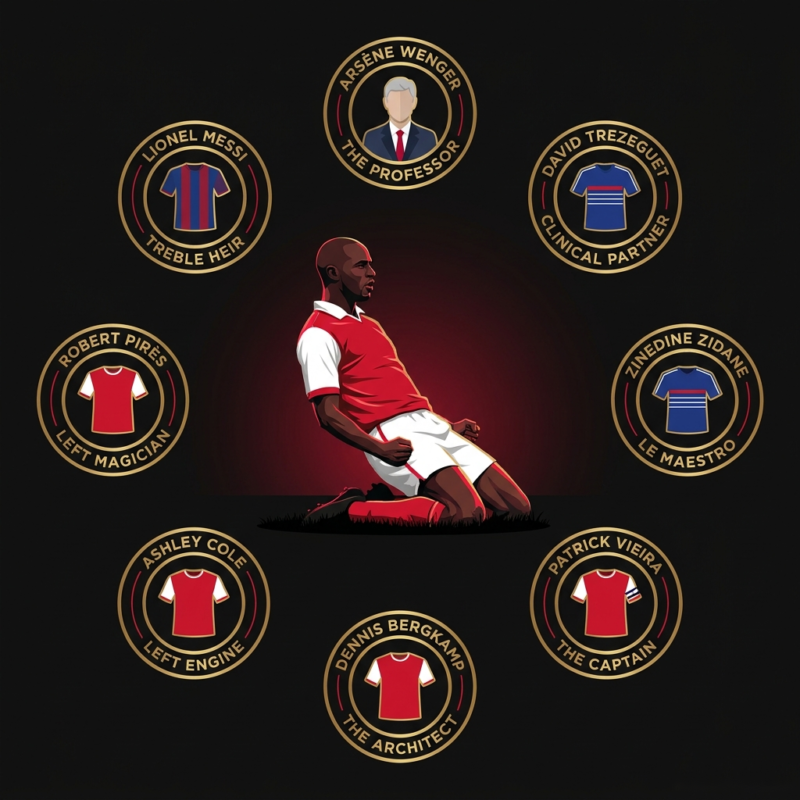
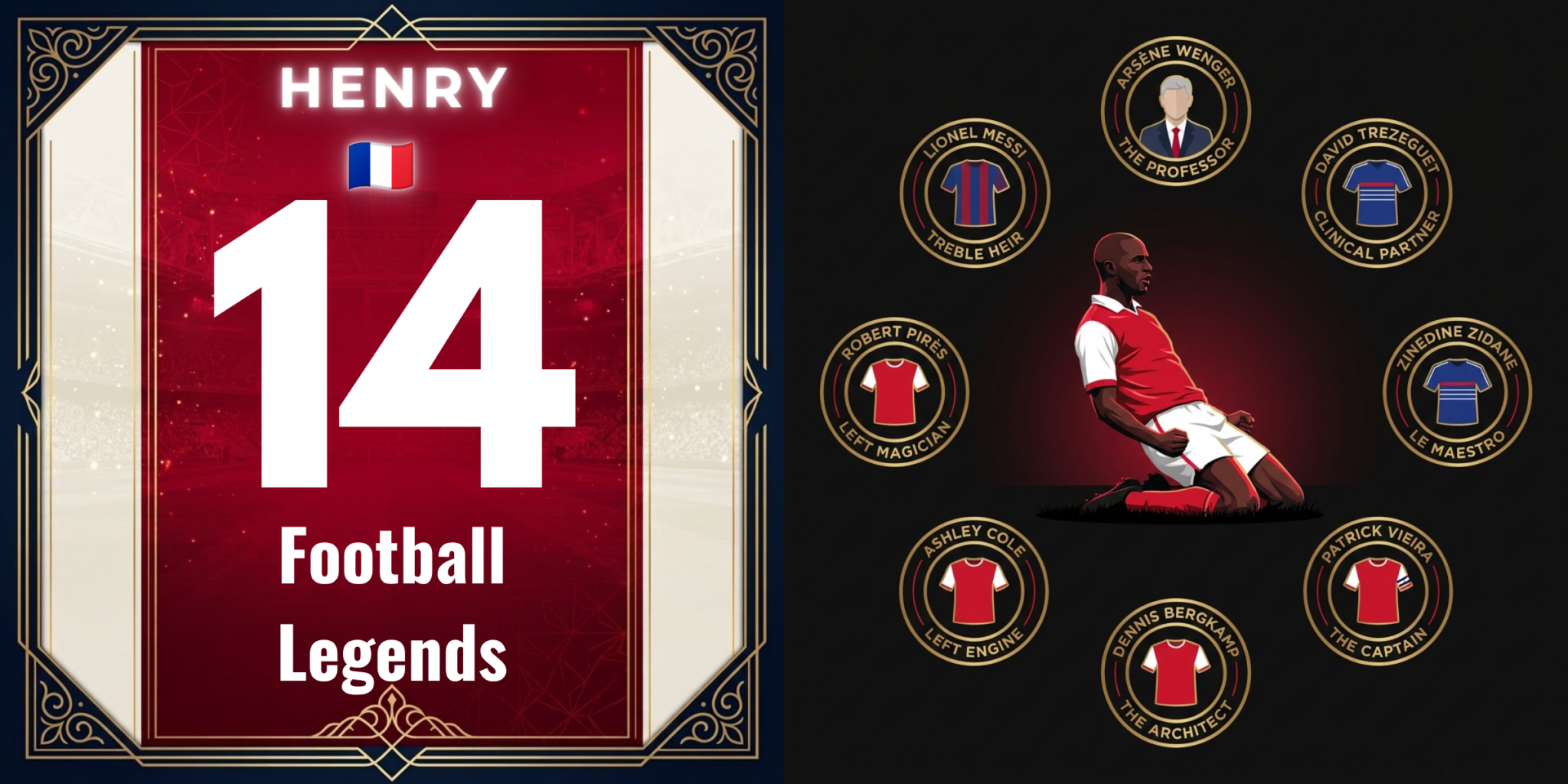
From a “restless blue bullet” to the undisputed monarch of Highbury, Thierry Henry’s brilliance was amplified by eight defining figures who shaped his tactical evolution—arranged clockwise starting from the 12 o’clock apex:
① Arsène Wenger (12 o’clock: The Professor / Architect of the Positional Transformation)
“Your talent is far too vast to remain confined to the touchline.” After handing a 17-year-old Henry his professional debut at AS Monaco, “The Professor” rescued his struggling protégé from Juventus in August 1999. By orchestrating Henry’s radical conversion from winger to roving centre-forward, Wenger unlocked the greatest striker in Premier League history.
② David Trezeguet (1 o’clock: Clinical Partner / The Twin Spear of Clairefontaine)
Henry’s lifelong brother-in-arms since their formative days at the Clairefontaine academy, sharing the front line at both Monaco and the French national team. While Henry drifted wide to create chaos, Trezeguet operated as a lethal penalty-box predator—a synergy immortalized at the 1998 World Cup and Trezeguet’s dramatic golden goal in the UEFA Euro 2000 Final.
③ Zinedine Zidane (3 o’clock: Le Maestro / General of Les Bleus)
The sovereign playmaker alongside whom Henry conquered the 1998 World Cup and Euro 2000. Though direct goal combinations between the two icons were famously rare, their telepathy peaked on July 1, 2006, when Zidane’s curling free-kick met Henry’s side-footed volley to eliminate reigning champions Brazil (1–0) in the World Cup quarter-finals.
④ Patrick Vieira (5 o’clock: The Captain / Colossal Shield of the Midfield)
Henry could glide freely across the attacking third because Arsenal’s midfield general ruthlessly snuffed out opposition transitions and launched immediate, line-breaking vertical passes into his stride. Following Vieira’s departure to Juventus in the summer of 2005, Henry inherited his revered captain’s armband.
⑤ Dennis Bergkamp (6 o’clock: The Architect / The Ultimate Telepathic Partner)
Positioned directly opposite Wenger at 6 o’clock is the Dutch genius Henry reveres as the greatest partner of his career. Whenever Bergkamp dropped into the hole to drag central defenders out of position, Henry surged diagonally into the vacated space behind them—forming the most artistic strike partnership English football has ever witnessed.
⑥ Ashley Cole (7 o’clock: Left Engine / The Overlapping Speedster)
The moment Henry received the ball in the left channel, Cole’s lung-busting overlapping runs on the outside tore opposing right-backs in two. His relentless width acted as the ultimate decoy, prizing open the interior half-space for Henry to cut inside into his 45-degree sanctuary.
⑦ Robert Pirès (9 o’clock: Left Magician / Co-Conspirator of the Left Channel)
When Henry drifted wide into the “Henry Zone,” Pirès seamlessly tucked inside while Cole bombed down the touchline. This dizzying rotational carousel on Highbury’s left flank—an early precursor to modern positional play—made Pirès the creative artist with whom Henry shared his most telepathic combinations.
⑧ Lionel Messi (11 o’clock: Treble Heir / The Torch-Bearer at Camp Nou)
The burgeoning Argentine phenomenon Henry partnered at FC Barcelona. In the historic 2008–09 campaign, Henry selflessly patrolled the left wing to create space for a young Messi in the centre, combining with Samuel Eto’o to plunder 100 goals across all competitions and capture an unprecedented Spanish Treble.
🕊️ The Human Dimension | Altruism Over Ego, The Trick Penalty & The Paris Silver

1. “More Proud of Assists Than Goals” | The Anti-Egoist Ethos
Among Henry’s many philosophical reflections, one principle towers above the rest:
“A striker is not just someone who pushes the ball over the line. If a teammate is in a better position, you must pass. Throughout my career, I was always prouder of the assists I provided than the goals I scored.”
Having claimed a record four Premier League Golden Boots, the man who netted 175 league goals was simultaneously a chief architect of collective harmony, recording 74 assists in the Premier League alone (including a joint-record 20 in the 2002–03 campaign). Rather than demanding personal glory at every turn, Henry elevated football into a shared, selfless art form.
2. Cruyffian Ambition & The Comedic Trick Penalty (2005)
Even perfectionists have their moments of endearing human error. On October 22, 2005, in a Premier League fixture against Manchester City (a 2–1 win), Arsenal earned a penalty kick while leading 1–0.
Henry and Robert Pirès conspired to recreate the legendary “two-man penalty” originally executed by Johan Cruyff and Jesper Olsen for Ajax in 1982. Pirès attempted to gently roll the ball forward for an onrushing Henry to hammer home, but his boot merely grazed the surface, leaving the ball stranded for defender Danny Mills to comfortably clear. Post-match, Henry smiled wryly: “The idea itself was brilliant, but it turned out to be the biggest mistake of my life.” That playful nod to football’s pioneers—and his occasional touch of mischief—only deepened the fans’ affection.
3. The Highbury Gaze & The Silver in Paris
In December 2011, to mark Arsenal’s 125th anniversary, a bronze statue of Henry was unveiled outside the Emirates Stadium.
The sculpture immortalizes his iconic celebration from a November 16, 2002 North London Derby against Tottenham (a 3–0 win), where he surged 70 yards from his own half before sliding on his knees across the turf. Its gaze is fixed forever toward Highbury.
Following his retirement in December 2014, Henry established himself as an articulate, insightful pundit for Sky Sports and CBS Sports, while pursuing coaching. After serving as assistant coach for Belgium—helping them secure a historic 3rd-place finish at the 2018 World Cup—he managed AS Monaco and Montreal Impact, before taking charge of the France Under-21 and Olympic teams. Guiding Les Bleus to a silver medal at the Paris 2024 Olympic Games, Henry continues to channel his fierce passion into shaping the next generation.
💡 Conclusion | The King Who Kissed the Highbury Turf and Redefined the Modern Striker

A quarter-century has passed since the explosive speed of a 20-year-old shook the world at the 1998 World Cup.
The “restless blue bullet”—once stranded out wide and bogged down by defensive duties in Turin—was reborn through a fateful reunion with Arsène Wenger and a radical positional transformation into a central striker, ascending the throne as the ultimate monarch of Highbury.
Towering at 188 cm (6 ft 2 in), he glided past defenders with weightless grace, kept the ball glued to his foot at maximum velocity, and bent trademark right-footed finishes into the far corner from the left 45-degree sanctuary (the “Henry Zone”).
Above all, despite claiming a record four Premier League Golden Boots, he valued assists just as much as goals, painting the pitch with breathtaking harmony alongside Dennis Bergkamp and Robert Pirès.
Fast, towering, silk-smooth, and infinitely intelligent.
The legacy Henry carved into the green carpet of Highbury alongside his iconic No. 14 shirt remains the ultimate blueprint for modern attackers like Kylian Mbappé, continuing to illuminate stadiums across the globe.
Let us keep smiling and enjoying football today as well!
Until next time—Jonoren here.
📚 Related Tactical Reads | Explore the Lineage Behind the King:
Discover the tactical philosophy and player-development alchemy of his mentor Arsène Wenger:
👉 Arsène Wenger | The Alchemy of Turning Raw Diamonds into Football Royalty
Trace the origin of the iconic No. 14 shirt, the original 1982 two-man penalty, and the genius who unearthed Dennis Bergkamp:
👉 Johan Cruyff | Space, Geometry, and the Architect Who Rebuilt Modern Football
Revisit the golden era of 1990s–2000s tactical discipline with our ultimate hypothetical lineup built around Hidetoshi Nakata:
👉 Fantasy XI | Capello’s Disciples Built Around Hidetoshi Nakata — One Player Per Nation
👉 Players Archive | Legends & Tactical Profiles
👉 Fantasy XI & Selections Archive | All-Time Lineups & Tactical Experiments