Welcome back—Jonoren here.
The football icon we are profiling today is Manchester United’s immortal one-club bandiera: Wales’s own Ryan Giggs.
| From the lightning-fast Welsh katana to the cerebral deep-lying playmaker: ‘The master of Area 11 who conquered the flanks for the Red Devils.’ |
29 November marks the birthday of Ryan Giggs.
As recently explored in our tactical study, The History of Football Wingers, Giggs stands as the quintessential embodiment of the British touchline heritage, having terrorised defences in the iconic No. 11 shirt across three different decades.
His career statistics read like mythical folklore: an all-time record 13 Premier League titles, a club-record 963 competitive appearances for Manchester United, and an unmatched 162 Premier League assists—standing more than 50 clear of any rival in competition history.
Yet his enduring majesty transcends raw silverware. How did a blistering speedster—once described by Steve Bruce as ‘running like the wind, with effortless grace and complete silence’—reinvent himself at 35 into an exquisite central midfield controller, claiming the PFA Players’ Player of the Year award? And how did he navigate 24 seasons in the world’s most fiercely physical league without receiving a single red card for Manchester United?
Let’s unpack the pride behind the iconic No. 11 shirt, his complete career stats, and the tactical brilliance of the Red Devils’ greatest servant.
- My Encounter with Giggs | Eric Cantona, The Red Devils & The Running Prodigy
- Profile | Shirt No. 11, Height, Position & Career Benchmarks
- Style of Play | What Made Him Unstoppable? The 3 Core Pillars
- Tactical Parameter Evaluation | Attacking, Technique, Pace, Stamina
- Club Career Highlights | 24 Seasons as a One-Club Man, Triumph & Renewal
- 1. The Debut & First Wonderboy (1990–1995) | A Knock on the Door on His 14th Birthday
- 2. Fergie’s Fledglings & The Immortal 1999 Treble (1995–2000) | The Miracle of Camp Nou
- 3. Adversity Overcome & The Rain of Moscow (2000–2010) | Surpassing Sir Bobby Charlton
- 4. Living Legend & The Final Curtain (2010–2014) | The Player-Manager’s Farewell
- International Career | Welsh Pride & The 2012 Olympic Milestone
- Tactical Interplay Network | Ferguson, Best & The Defining Figures Around Giggs
- The Human Dimension | One-Club Loyalty, Adaptive Intellect & Unflinching Discipline
- Conclusion | The Immortal Bandiera Who Dedicated Everything to the Red Devils
My Encounter with Giggs | Eric Cantona, The Red Devils & The Running Prodigy
My personal introduction to the genius of Ryan Giggs occurred in the early 1990s, when the talismanic Eric Cantona held court at the Theatre of Dreams.
Growing up with the legendary manga Captain Tsubasa, my childhood perception of pure wingers was shaped by functional wide operators like Taki—diligent workers who hugged the touchline to supply the central strikers. Compared to goalscorers, dribblers always felt like supporting cast members.
The teenage Ryan Giggs shattered that preconception with explosive finality.
When Giggs carried the ball, his forward velocity did not diminish; astonishingly, he appeared to accelerate while dribbling. His sudden drops of the shoulder and instantaneous cuts across the defender’s centre of gravity left elite right-backs frozen in their tracks. While British commentators routinely likened his running style to a ‘flick-knife’ or ‘jackknife’, to my eyes—viewed through an appreciation of aesthetic elegance and lethal sharpness—his left foot was a finely forged Japanese katana.
‘Don’t pass the ball—just keep driving forward!’ I remember clenching my fists before the television screen late into the night, completely mesmerised by that flashing left boot.
Let’s begin by surveying Giggs’s definitive career benchmarks and profile.
Profile | Shirt No. 11, Height, Position & Career Benchmarks

| ① Full Name | Ryan Joseph Giggs (Born Ryan Joseph Wilson) |
|---|---|
| ② Nationality (& Roots) | Wales (Cardiff, Canton / Raised in Salford, Greater Manchester; Sierra Leonean grandfather on paternal side) |
| ③ Date of Birth | 29 November 1973 |
| ④ Height | 180 cm (5 ft 11 in) |
| ⑤ Weight | 72 kg (159 lbs) |
| ⑥ Preferred Foot | Left (Right-handed) |
| ⑦ Primary Roles | Left Winger / Wide Midfielder / Central Midfielder / Deep-Lying Playmaker |
| ⑧ Domestic League Career | 1990–2014: Manchester United (24 seasons) ・Domestic League: 672 appearances, 114 goals (Premier League: 632 apps, 109 goals; First Division: 40 apps, 5 goals) ・Total Competitive Club Career: 963 appearances, 168 goals (All-time club record) |
| ⑨ International Career | ・Wales National Team (1991–2007): 64 caps, 12 goals ・Great Britain Olympic Football Team (2012 London Olympics Captain): 4 caps, 1 goal |
| ⑩ Major Tournament Record | ・World Cup / UEFA Euro Tournaments: Did not qualify ・Olympic Games: 2012 London Olympics (Quarter-finals; all-time oldest goalscorer in Olympic football history at 38 years, 243 days) |
| ⑪ Iconic Shirt Numbers | Club: No. 11 (Manchester United) Country: No. 11 (Wales, Team GB) |
| Major Club Honours | ・Premier League: 13 titles (all-time individual record) ・FA Cup: 4 titles (1993–94, 1995–96, 1998–99, 2003–04) ・League Cup: 4 titles (1991–92, 2005–06, 2008–09, 2009–10) ・UEFA Champions League: 2 titles (1998–99, 2007–08) ・Intercontinental Cup: 1 title (1999 MVP) ・FIFA Club World Cup: 1 title (2008) |
| Major Individual Awards & Records | ・Premier League All-Time Assist Record: 162 assists (UEFA Champions League: 41 assists) ・PFA Players’ Player of the Year: 2008–09 (at 35) ・PFA Young Player of the Year: 2x (1991–92, 1992–93; first back-to-back winner in history) ・Scored in 21 consecutive Premier League seasons (23 consecutive top-flight seasons) ・Played in 22 consecutive Premier League campaigns ・Manchester United Discipline: Zero red cards across 24 seasons and 963 competitive matches |
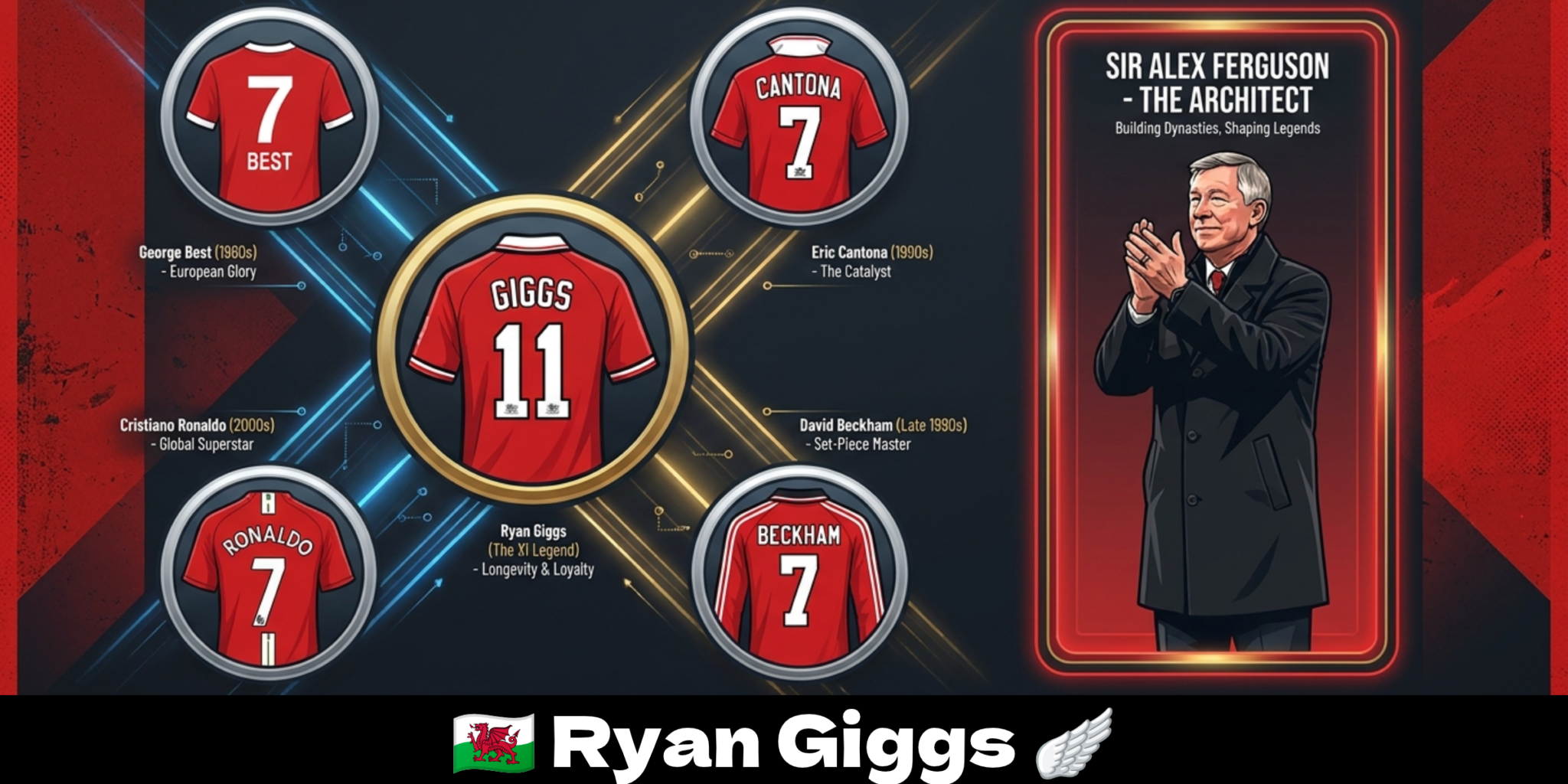
| The Legacy of Shirt No. 11: While Old Trafford’s iconic No. 7 became a rotating mantle inherited by generational icons—from George Best and Eric Cantona to David Beckham and Cristiano Ronaldo—the No. 11 jersey was the sovereign, uninterrupted property of Ryan Giggs for nearly a quarter of a century. Borrowing from baseball icon Ichiro Suzuki’s famed ‘Area 51’, Giggs’s total territorial command over the left flank earned him the immortal title of ‘The Master of Area 11.’ |
Style of Play | What Made Him Unstoppable? The 3 Core Pillars
If one were to capture Ryan Giggs’s tactical evolution in a single definition, he was ‘a thoroughbred touchline winger blessed with electrifying acceleration who evolved at 35 into an imperious, cerebral deep-lying orchestrator.’
Throughout modern football history, as the winger position underwent dramatic shifts from traditional touchline crossers into defensive wide midfielders and inverted inside forwards, Giggs stood as the bridge. He mastered the traditional 4-4-2 flank duel in his youth, and then completely re-engineered his technical identity to dominate the modern era. His greatness rests upon three definitive tactical pillars:
1. Unstoppable Acceleration & The ‘Katana’ Dribble | Top Speed Without Breaking Stride
In his prime, Giggs’s defining attribute was his extraordinary burst of speed down the left touchline. Blessed with explosive hip mobility and an innate sense of physical equilibrium inherited from his rugby league player father, Danny Wilson, Giggs could shift into top gear almost instantaneously.
Crucially, his dribbling was characterised by an astonishing biomechanical economy: his stride length never shortened when handling the ball. Defenders anticipating a heavy touch were routinely humiliated; the ball remained glued to his left instep at maximum velocity. A subtle drop of the shoulder or a sudden outside flick was enough to shatter the defender’s recovery balance entirely.
| “He possessed the unique ability to glide across uneven pitches without breaking stride. When Ryan was at full sprint, his feet barely made contact with the grass—he was completely silent, running like the wind.”— Steve Bruce (Manchester United Captain & Teammate) “I have only wept twice in my life while watching another football player: the first was Diego Maradona, and the second was Ryan Giggs.”— Alessandro Del Piero (Juventus & Italy Legend) |
This blistering capacity was immortalised on 14 April 1999, in the FA Cup Semi-Final replay against Arsenal at Villa Park. With United down to ten men in extra time and the scores locked at 1–1, Giggs pounced on a loose horizontal ball from Patrick Vieira inside his own half.
Igniting his afterburners, Giggs carried the ball over 60 metres, slicing between Lee Dixon and Martin Keown, leaving Tony Adams grasping at thin air, before firing an unstoppable left-footed strike into the roof of the net past David Seaman from an impossibly tight angle. Tearing off his shirt and whirling it above his head in ecstasy, Giggs sealed the most iconic solo goal in FA Cup history—and preserved United’s historic Treble dream.
2. Positional Reinvention at 35 & 162 All-Time Assists | Orchestrating from Deep
“At 25, Ryan would shatter full-backs with his pace; at 35, he controls the rhythm from deep.” Sir Alex Ferguson’s assessment highlighted the genius of Giggs’s second act.
During the 2008–09 campaign, facing the natural athletic decline that accompanies mid-thirties football, Giggs executed a seamless positional transition from the touchline into central midfield, operating as a deep-lying playmaker (regista).
Rather than attempting to outpace opposition full-backs, he utilised his panoramic vision, pristine first touch, and masterclass spatial cognition. Stationed in the central engine room, he manipulated passing lanes, dictated the tempo of transitions, and delivered incisive vertical passes into the channels with surgical precision.
His record of 162 Premier League assists stands as an untouchable monument in English football history, towering over second-placed Cesc Fàbregas (111 assists) by over 50. It serves as undeniable proof that Giggs was not merely a speedster, but one of the most prolific creative intellects the game has ever seen. This masterful tactical conversion culminated in him winning the prestigious PFA Players’ Player of the Year award in 2008–09 at 35.
3. 24 Seasons Powered by Yoga & Zero Red Cards | The Pinnacle of Professionalism
That Ryan Giggs sustained elite performance at the pinnacle of European football until the age of 40 was the product of ferocious self-discipline and pioneering physical conditioning.
In his late twenties, plagued by recurrent hamstring tears that threatened his career longevity, Giggs completely revamped his lifestyle around 2005 by incorporating intensive, tailored yoga sessions into his daily regime. By restoring pelvic alignment, core stability, and hamstring flexibility, he banished muscle breakdowns and maintained extraordinary physical elasticity into his late thirties.
Manchester United maintained an unyielding club policy of offering only one-year rolling contracts to players over the age of 30. Giggs shattered that precedent, repeatedly earning multi-year extensions through the sheer undeniable standard of his fitness and performances.
Most extraordinarily, across 963 competitive matches for Manchester United in the combat-heavy theatre of English football, Ryan Giggs was never sent off. Not once. In an era punctuated by ferocious tackling and tactical provocation, he maintained sublime emotional equilibrium—channeling every drop of his competitive fire into the execution of football.
Tactical Parameter Evaluation | Attacking, Technique, Pace, Stamina

| Attribute | Rating | Tactical Breakdown & Analysis |
|---|---|---|
| Attacking | ★★★★★ (5/5) | All-time Premier League record 162 assists; scored in 21 consecutive Premier League seasons; elite conversion in transitional moments. |
| Defending | ★★★☆☆ (3/5) | Diligent defensive tracking within Ferguson’s classic 4-4-2; evolved into a disciplined positional screen in central midfield in his thirties. |
| Technique | ★★★★★ (5/5) | Velvet first touch with the outside of the left boot; surgical delivery from open play and set pieces; sublime spatial weight of pass. |
| Pace / Acceleration | ★★★★★ (5/5) | Unrivalled linear acceleration and body swerve in his prime; replaced physical velocity with cognitive speed and anticipation later in his career. |
| Stamina & Longevity | ★★★★★ (5/5) | Pioneering yoga regimen that enabled 963 competitive club appearances; sustained international and Champions League standards until age 40. |
Attacking ‘5’, Technique ‘5’, Pace ‘5’, Stamina & Longevity ‘5’. These ratings represent the culmination of 24 seasons at football’s highest altitude—an enduring testament to his stature as the most decorated player in English football history.
Club Career Highlights | 24 Seasons as a One-Club Man, Triumph & Renewal
1. The Debut & First Wonderboy (1990–1995) | A Knock on the Door on His 14th Birthday
The Ryan Giggs dynasty began on his fourteenth birthday. Having shone for local side Deans FC and caught the eye at Manchester City’s School of Excellence, Giggs was playing for Salford Boys against United’s Under-15s, netting a breathtaking hat-trick. On 29 November 1987, Alex Ferguson personally knocked on the door of the Wilson household to secure his registration for Manchester United.
Turning professional on 1 December 1990—just two days after his 17th birthday—Giggs made his senior debut on 2 March 1991, against Everton at Old Trafford, coming on for Denis Irwin. Two months later, on 4 May 1991, he started the Manchester derby at Old Trafford and struck the only goal in a famous 1–0 triumph.
When the Premier League was launched in 1992–93, Giggs was the heartbeat of United’s first league championship in 26 years. He became the first player in history to claim back-to-back PFA Young Player of the Year awards (1991–92 and 1992–93). Amid intense media mania hailing him as ‘the new George Best’, Ferguson imposed a complete media blackout, fiercely shielding the young prodigy from media interviews until he turned 20.
2. Fergie’s Fledglings & The Immortal 1999 Treble (1995–2000) | The Miracle of Camp Nou
In the summer of 1995, Ferguson made the audacious gamble to sell established stars Mark Hughes, Paul Ince, and Andrei Kanchelskis, placing total faith in the Class of ’92: David Beckham, Paul Scholes, the Neville brothers, and Nicky Butt, led by their senior counterpart, Giggs. After an opening day defeat prompted Alan Hansen’s immortal quip—’You can’t win anything with kids’—United roared back to claim a domestic League and FA Cup Double.
The 1998–99 season delivered the crowning achievement of English club football: The Treble. Following his legendary solo winner in the FA Cup semi-final against Arsenal, Giggs started the Champions League Final against Bayern Munich at Camp Nou on 26 May 1999.
Trailing 1–0 in stoppage time, Giggs latched onto a cleared corner, scuffing an instinctive right-footed shot across the box that Teddy Sheringham steered home for the equaliser, setting the stage for Ole Gunnar Solskjær’s historic winner seconds later. In November 1999, Giggs set up Roy Keane’s winning goal in Tokyo against Palmeiras (1–0), claiming the Intercontinental Cup and the Man of the Match award as club champions of the world.
3. Adversity Overcome & The Rain of Moscow (2000–2010) | Surpassing Sir Bobby Charlton
The journey was not without turbulence. In the early 2000s, chronic hamstring tears compromised his explosive acceleration, leading to a temporary dip in form during the 2002–03 campaign that drew rare murmurs of discontent from the Old Trafford crowd amid persistent transfer speculation linking him with Inter Milan.
Giggs’s response was defiant. Reaffirming his absolute loyalty to United, he delivered a masterclass brace in a 3–0 demolition of Juventus at the Stadio Delle Alpi in February 2003, reigniting his career. Embracing yoga around 2005, he rebuilt his athletic foundation from the core outward.
In May 2007, he clinched his ninth league championship, breaking the English record previously held by Alan Hansen and Phil Neal. Then, on 21 May 2008, in the torrential rain of Moscow, Giggs came off the bench in the 87th minute of the Champions League Final against Chelsea. It was his 759th appearance for Manchester United, officially eclipsing Sir Bobby Charlton’s long-standing club appearance record (758). In the ensuing sudden-death penalty shootout, Giggs coolly stroked home the decisive seventh penalty, delivering his second European Cup triumph.
4. Living Legend & The Final Curtain (2010–2014) | The Player-Manager’s Farewell
Operating in central midfield in his late thirties, Giggs continued to break records with astonishing regularity. In April 2011, he netted against Schalke 04 in the Champions League semi-final to become the oldest goalscorer in tournament history at the time. In February 2012, making his 900th competitive appearance for United, he struck a dramatic 90th-minute winner against Norwich City.
In March 2013, he achieved his 1,000th senior career appearance against Real Madrid at Old Trafford, collecting his 13th Premier League winner’s medal alongside Sir Alex Ferguson’s emotional retirement at the conclusion of that campaign.
Appointed player-coach under David Moyes for 2013–14, Giggs took interim charge as player-manager for the final four matches of the season following Moyes’s departure in April 2014. On 6 May 2014, against Hull City at Old Trafford, Giggs substituted himself on in the 70th minute, delivering a characteristically crisp passing cameo in what proved to be his final match as a professional footballer.
On 19 May 2014, in an open letter to the supporters, Ryan Giggs officially announced his retirement from playing. 24 seasons, 963 appearances, 168 goals, and 34 major trophies. No player in the annals of British football has ever walked a path of such sustained, singular majesty.
International Career | Welsh Pride & The 2012 Olympic Milestone

Across 64 international caps and 12 goals for Wales, Giggs’s international career was defined by fierce national pride, even as qualification for a major tournament eluded his generation.
1. The England Eligibility Myth & Unwavering Identity
Because Giggs had captained England Schoolboys under the name Ryan Wilson in 1989, a persistent myth endured among casual supporters that he had ‘chosen’ Wales over England. In truth, schoolboy eligibility was determined solely by the location of the school attended (Salford), whereas full international selection was governed strictly by ancestral bloodlines. Both of Giggs’s parents and all four grandparents were Welsh.
More fundamentally, Giggs himself silenced any ambiguity in 2002: ‘I would rather have missed out on major tournaments than play for a country to which I did not belong. I am Welsh through and through; I never had any desire to wear any other shirt.’
Making his senior Wales debut at age 17 against Germany in October 1991, Giggs endured domestic criticism early in his career for missing 18 consecutive friendly matches between 1991 and 2000. In his autobiography, Giggs clarified that this was a medical necessity agreed upon with Ferguson to protect his vulnerable hamstrings from the shock of two matches per week. On June 2, 2007, he captained Wales in a 0–0 draw against the Czech Republic in Cardiff, earning Man of the Match honors in his final international appearance before stepping aside to prolong his club career.
2. 2012 London Olympics | Captaining Team GB at Age 38
Denied a stage at the World Cup or European Championships, history provided Giggs with a grand international showcase in the twilight of his career.
Selected as one of three overage players and handed the captain’s armband for the Great Britain Olympic football team at the London 2012 Games, Giggs led Team GB into their first Olympic campaign in 52 years.
On 29 July 2012, at Wembley Stadium against the United Arab Emirates (a 3–1 victory), Giggs met a cross from the left flank with a clinical far-post header into the net. Aged 38 years and 243 days, he shattered an 88-year-old international milestone, becoming the oldest goalscorer in Olympic football tournament history. Standing with arms outstretched before 85,000 spectators, the Welsh bandiera etched his name permanently onto the Olympic record books.
Tactical Interplay Network | Ferguson, Best & The Defining Figures Around Giggs
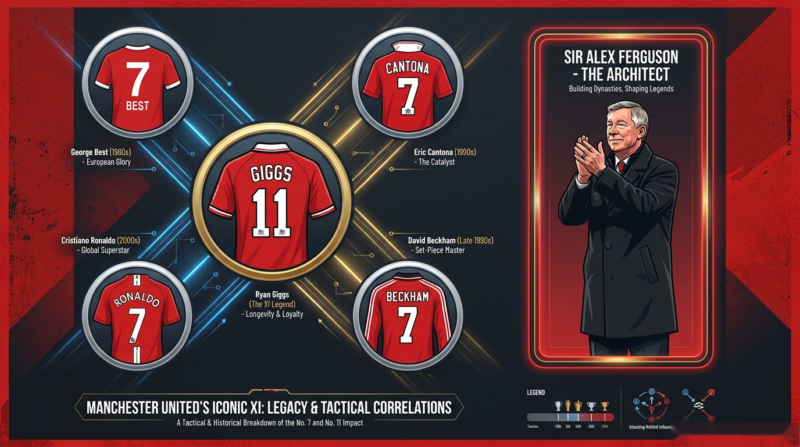
Ryan Giggs’s 24-year journey was elevated through deep synergy with eight pivotal figures in Manchester United and British football history:
• Sir Alex Ferguson (The Father Figure / Architect of Longevity): Visited Giggs’s home on his 14th birthday, shielded him from the media until 20, and orchestrated his transition into central midfield at 35. The greatest and most enduring manager-player partnership in modern football history.
• George Best (The Predecessor / Red Devil Flank Royalty): The benchmark against whom Giggs was constantly compared. Best frequently visited The Cliff training ground to watch the young Welshman sprint, famously declaring: ‘One day they might even say that I was another Ryan Giggs.’
• Eric Cantona (The King / Infuser of the Winner’s Mentality): Arrived in November 1992 and transformed United into champions. Cantona’s swagger, technical charisma, and work ethic provided the perfect tactical shield under which Giggs could freely express his attacking artistry.
• David Beckham (Class of ’92 / The Symmetrical Twin Wing): Giggs on the left with explosive dribbling and acceleration; Beckham on the right with pinpoint diagonal crossing. Together, they established the definitive wide midfield blueprint of the 1990s 4-4-2 formation, culminating in the 1999 Treble.
• Paul Scholes (Class of ’92 / The Ultimate Midfield Soulmate): Class of ’92 brother who shared the pitch with Giggs for two decades. It was Scholes whom Giggs replaced in the 2008 Champions League Final to break Charlton’s appearance record, and alongside whom he orchestrated midfield tempos throughout their thirties.
• Roy Keane (The Captain / Midfield Engine): The ferocious driving heartbeat of United from 1993 to 2005. Keane and Giggs are the only players in Manchester United history to win four FA Cup titles together, their telepathy highlighted by Keane’s winner in the 1999 Intercontinental Cup.
• Cristiano Ronaldo (The Next-Gen Prodigy / Mentored Heir): Arrived in 2003 as the heir to United’s wide legacy. As Giggs shifted into central midfield, he acted as the tactical mentor and balancing shield, allowing Ronaldo to unleash his full attacking potential during the 2007–08 Champions League conquest.
• Gary Neville (Class of ’92 / Brother-in-Arms & Lifelong Business Partner): Formed the defensive and tactical backbone of the club alongside Giggs for 20 years. Following retirement, their brotherhood extended into co-owning Salford City FC, founding University92 (UA92), and spearheading major hotel ventures.
The Human Dimension | One-Club Loyalty, Adaptive Intellect & Unflinching Discipline

1. The 963-Game One-Club Legacy | Unrivalled Staying Power
In an era of hyper-commercial player mobility, spending 24 consecutive seasons at a single global superclub—fending off every world-class challenger signed to replace him—stands as an extraordinary feat of will.
When Giggs achieved his 900th appearance, Sir Alex Ferguson remarked: ‘It is almost inconceivable that any player will ever play 900 matches for a single club again.’ His daily routine—arriving first at the training ground, setting the professional tone, and leaving last—was the real foundation of his longevity.
2. Fearless Evolution | Relinquishing Speed to Master Space
“If I had clung to my identity as a flying winger, I would have been finished at 31.” Giggs understood that true longevity requires the humility to shed one’s former self.
Rather than lamenting the loss of his sprint speed, he overhauled his physiology through yoga and recalibrated his mental clock to dictate matches from deep. Only those willing to reinvent their tactical purpose can truly conquer the test of time.
3. Unflinching Discipline & Welsh Loyalty | Choosing Roots Over Trophies
Competing in 963 competitive matches in the furnace of English football without receiving a single red card is a monumental tribute to his emotional intelligence.
Routinely targeted by cynical challenges and shirt-pulling, Giggs never retaliated. He simply retrieved the ball and prepared for the next phase. Combined with his unflinching commitment to his Welsh ancestry—rejecting any opportunistic pursuit of international tournaments—Giggs embodied a brand of quiet integrity that commanded universal respect across the footballing world.
Conclusion | The Immortal Bandiera Who Dedicated Everything to the Red Devils

A quarter of a century has passed since a 14-year-old boy welcomed Alex Ferguson into his living room in Salford.
From the electric Welsh katana who dismantled backlines with unplayable acceleration, to the cerebral general who orchestrated Champions League conquests from deep, Ryan Giggs offered his entire youth, maturity, and intellect to Manchester United.
Fast, surgical, resilient, and utterly dignified.
The legacy he inscribed onto the pitch of Old Trafford alongside the iconic No. 11 shirt remains woven into the club’s eternal soul.
Let’s keep smiling and enjoying football today as well. ⚽✨
👉 Players Archive | Legends & Tactical Profiles
👉 Fantasy XI & Selections Archive | All-Time Lineups & Tactical Experiments