Welcome back—Jonoren here.
Alongside our analytical features, I occasionally open the doors of our casual salon: “Football Columns.” The pitch offers an inexhaustible theatre across past, present, and future—open to anything and everything touched by the beautiful game.
Sometimes we drift lightheartedly across nostalgic trivia; other times, we dive deep into the strategic foundations of the sport. Today, however, is a journey into personal archaeology. Rather than presenting a polished tactical essay, I want to share my unfiltered football thoughts straight from memory—unpredictable, unhurried, and straight from the heart.
Our theme for this inaugural column:
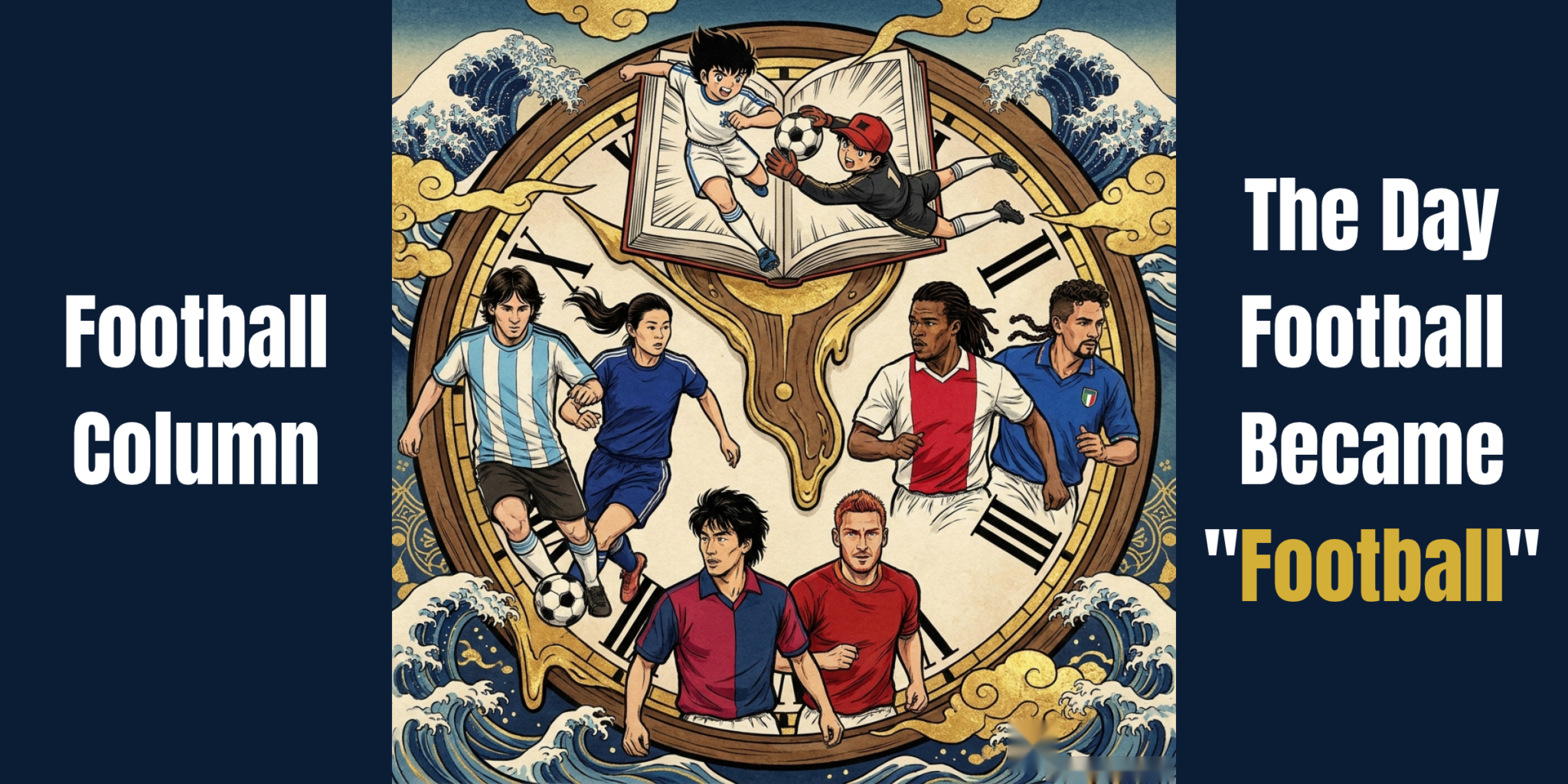
✦ The Day Football Became “Football”
And so, the curtain rises.
- Present to Past | A Reverse Chronology of Memory
- Four Decades of Football Awakening: Reverse Timeline Summary
- 1. The 2010s to Late 2000s | Jubilation, Global Strides & Virtual Drafts
- 2016 | The Miracle of Leicester City
- 2014 & 2012 | Japanese Pioneers Conquering European Cathedrals
- 2011 | Nadeshiko Japan’s World Cup Coronation
- Mid-2000s | Weekends Lost in Winning Eleven & WCCF Arcades
- 2006 | My Maiden World Cup Pilgrimage Abroad (Argentina vs. Mexico)
- 2002 | My First Live World Cup Experience (Argentina vs. Sweden)
- 2. The Early 2000s to Late 1990s | Unlocking the World Stage
- 2001–2002 | Shinji Ono’s UEFA Cup Triumph & Rekindling the Ajax Flame
- 2000–2001 | Hidetoshi Nakata’s Scudetto & Nanami’s Asian Cup Volley
- 1999 | World Youth Runners-Up & The Bloom of the Golden Generation
- 1998 | The Crucible of France ’98 & The Omission of King Kazu
- 1997 | The Joy of Johor Bahru
- 1996 | The Sega Saturn ‘Sakatsuku’ Era & The Miracle of Miami
- 3. The Early 1990s | The J.League Explosion, Calcio Fever & Ajax Love
- 1995 | Ajax’s European Coronation & Sealing a Lifelong Allegiance
- Autumn 1994 | Kazu’s Serie A Frontier & Encountering the Ajax Phenomenon
- Summer 1994 | USA 1994 & My First Football Magazine
- Autumn 1993 | The Agony of Doha
- Spring 1993 | The J.League’s Historic Kick-off & Cable Television
- 1992 | The Yamazaki Nabisco Cup Prelude
- 4. The 1980s | The Manga Universe & The Deepest Recesses of Memory
- Captain Tsubasa: Junior Youth Arc | Conquering the World in Print
- Captain Tsubasa: Middle School Arc | Nankatsu and Toho’s Joint Miracle
- 1986 | The Mexico World Cup (A Retrospective Memory)
- The Ultimate Catalyst | A Lone Copy of Captain Tsubasa Volume 2
- The Outer Boundaries: Dr. Slump & Tom and Jerry (Strictly Disqualified)
- Epilogue: My Footballing Big Bang Was Born in Volume 2
Present to Past | A Reverse Chronology of Memory
Every single event, match, and tournament that surfaces along this journey carries enough emotional weight to fill an entire dedicated volume. Were I to dissect each one in full detail right now, we would wander hopelessly off track—so individual tactical deep dives are reserved for future editions.
Rather than consulting textbooks or verifying dates chronologically from birth, I have decided to let memory dictate its own course. We will wind the clock back through layers of joy, heartbreak, and discovery to locate the precise coordinates of “that fateful day.”
Let the great rewind commence!
Four Decades of Football Awakening: Reverse Timeline Summary
| Era / Decade | Defining Milestones & Cultural Anchor Points | Key Figures & Clubs | The Nature of Football Awakening |
|---|---|---|---|
| 1. The 2010s to Late 2000s (The Era of Global Stride & Digital Mastery) | ・2016: Leicester City’s impossible Premier League fairytale ・2014 & 2012: Honda (AC Milan #10) & Kagawa (Man United under Sir Alex) ・2011: Nadeshiko Japan’s World Cup triumph in Frankfurt ・Mid-2000s: All-night PES (Winning Eleven) & WCCF arcades (Birth of Fantasy XI) ・2006 & 2002: World Cup pilgrimages (Leipzig & Miyagi) | Shinji Okazaki, Keisuke Honda, Shinji Kagawa, Homare Sawa, Lionel Messi | Football as a global standard. Witnessing Japanese players conquer elite European arenas and experiencing World Cup football in the flesh. |
| 2. Early 2000s to Late 1990s (Unlocking the World Stage & The Golden Age) | ・2001–02: Shinji Ono lifts the UEFA Cup with Feyenoord; Dutch league on BS ・2000–01: Hidetoshi Nakata captures the Scudetto with AS Roma ・1999: World Youth Championship final in Nigeria (The Golden Generation) ・1998: France World Cup baptism; the shock omission of King Kazu ・1997: The Joy of Johor Bahru (Okano’s historic golden goal) ・1996: The Miracle of Miami & the inaugural Sega Saturn ‘Sakatsuku’ dynasty | Shinji Ono, Hidetoshi Nakata, Kazuyoshi Miura, Masayuki Okano, Wesley Sneijder | Football as cultural euphoria and heartbreaking reality. Transitioning from wide-eyed supporters to tactical connoisseurs of the international stage. |
| 3. Early 1990s (The J.League Explosion, Calcio Fever & Ajax Love) | ・1995: Ajax lifts the Champions League in Vienna; lifelong devotion sealed ・Autumn 1994: Kazu moves to Genoa (Serie A); broken nose against Baresi ・Summer 1994: USA 1994 World Cup; purchasing my first football magazine ・Autumn 1993: The Agony of Doha (92nd-minute Iraqi equaliser in Qatar) ・Spring 1993: Historic J.League kick-off & cable broadcasts of European leagues ・1992: The Yamazaki Nabisco Cup prelude (Zico, Lineker, Littbarski arrive) | Louis van Gaal, Clarence Seedorf, Roberto Baggio, Giuseppe Signori, Zico | Football as an all-consuming religion. Discovering the tactical brilliance of European football, the drama of national tragedy, and falling irrevocably in love with Ajax. |
| 4. The 1980s (The Manga Genesis & The Deepest Layers of Memory) | ・Captain Tsubasa: Junior Youth Arc (Japan conquering Europe in fiction) ・Captain Tsubasa: Middle School Arc (Nankatsu vs Toho joint championship) ・1986: Mexico World Cup (Maradona’s folklore learned retroactively) ・The Catalyst: Finding a lone copy of Captain Tsubasa Volume 2 at home ・Outer Boundaries: Dr. Slump & Tom and Jerry (Strictly disqualified) | Tsubasa Ozora, Genzo Wakabayashi, Kojiro Hyuga, Diego Maradona | Football recognised as an epic, dramatic sport for the first time. The true Big Bang triggered by opening a solitary comic book. |
1. The 2010s to Late 2000s | Jubilation, Global Strides & Virtual Drafts
2016 | The Miracle of Leicester City
Shinji Okazaki charging tirelessly across the frontline, chasing down lost causes and sacrificing his body to fuel Claudio Ranieri’s 5,000-to-1 fairytale Premier League title. At the time, I instinctively wondered, “Is Okazaki the first Japanese player to win the Premier League? Wait, didn’t Junichi Inamoto play for Arsenal?” In reality, it was Japan’s second English championship—following Shinji Kagawa’s triumphant campaign with Manchester United in 2012–13. Even so, witnessing a compatriot play such an indispensable role in modern football’s greatest miracle was breathtaking.
2014 & 2012 | Japanese Pioneers Conquering European Cathedrals
Keisuke Honda stepping onto the San Siro turf wearing AC Milan’s sacred No. 10 shirt. His globally televised unveiling—introducing the ambition of his “Little Honda”—was pure, unmistakable swagger that brought a knowing smile to my face.
Two years earlier, Sir Alex Ferguson personally scouted and recruited Shinji Kagawa to join Manchester United. For a fan who grew up worshipping the Theatre of Dreams during the halcyon days of Cantona, Giggs, and Beckham, seeing a Japanese playmaker celebrate a Premier League title as a pivotal member of the home side was an emotional milestone that defied belief.
2011 | Nadeshiko Japan’s World Cup Coronation
The morning of July 18, 2011, remains etched in my soul. Karina Maruyama’s heart-stopping extra-time strike against hosts Germany in the quarter-finals; Homare Sawa’s miraculous 117th-minute flick from a corner—reminiscent of Roberto Mancini—against the United States in the final; and the ice-cold composure of 20-year-old Saki Kumagai burying the decisive penalty into the top corner. Waking up to see Japan crowned champions of the world felt like an impossible dream turned reality.
Mid-2000s | Weekends Lost in Winning Eleven & WCCF Arcades
During the era when Wesley Sneijder and Rafael van der Vaart were electrifying Amsterdam, my weekends were invariably spent crammed into friends’ flats—five or six of us huddled around the console, battling furiously in Pro Evolution Soccer (Winning Eleven) until dawn broke.
In arcades, we surrendered ourselves to the collectible card phenomenon World Club Champion Football (WCCF). Meeting fellow purists through online forums, we staged our own high-stakes draft nights. While rival managers engaged in bidding wars for superstar strikers and goalkeepers, I imposed a strict self-imposed rule upon myself: “A 3-4-3 formation, strictly limited to one player per nation.”
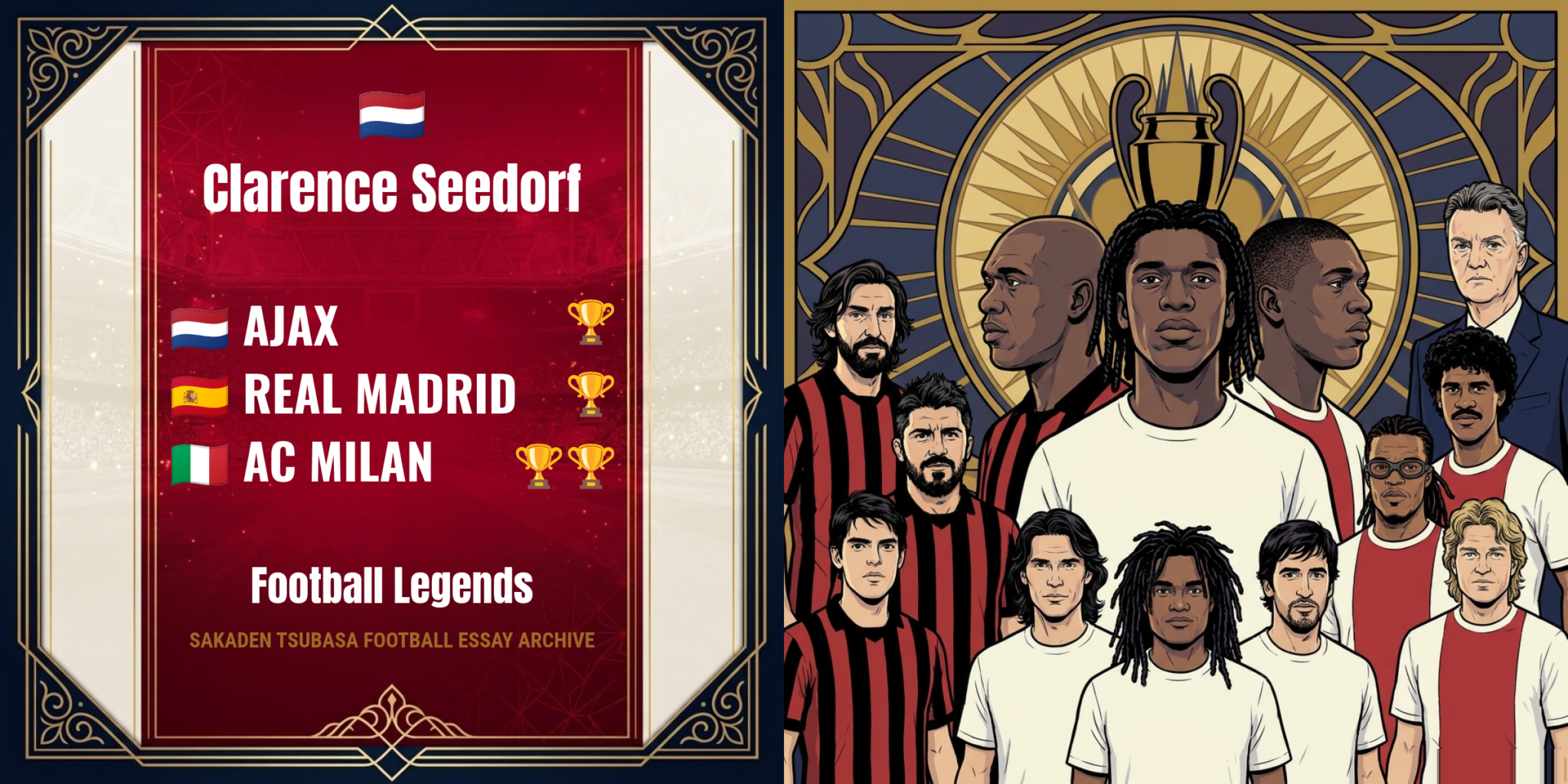
My undisputed, non-negotiable first overall pick? Clarence Seedorf. The visceral thrill of unveiling my tactical philosophy and unconventional lineup to an astonished room of managers—that exact spark of tactical imagination was the true genesis of the “Fantasy XI” series I write on this blog today.
2006 | My Maiden World Cup Pilgrimage Abroad (Argentina vs. Mexico)
Leipzig, Germany, June 24, 2006. Standing inside the Zentralstadion, witnessing Lionel Messi live on his 19th birthday—and watching Maxi Rodríguez unleash that legendary, chest-controlled dipping volley in extra time to seal a 2–1 victory right before my eyes. Around this period, I subscribed to satellite television (SKY PerfecTV!), ravenously consuming UEFA Champions League football late into the night.
2002 | My First Live World Cup Experience (Argentina vs. Sweden)
Miyagi Stadium, June 12, 2002. An indelible 1–1 stalemate that eliminated Marcelo Bielsa’s heavily favoured Argentina. Yet the image that outshone all match action was Claudio Caniggia—an unused substitute on the bench—being shown a straight red card by referee Ali Bujsaim for verbal dissent on the stroke of half-time! That afternoon also marked my first sighting of a towering young Swedish forward named Zlatan Ibrahimović.
2. The Early 2000s to Late 1990s | Unlocking the World Stage
2001–2002 | Shinji Ono’s UEFA Cup Triumph & Rekindling the Ajax Flame
Shinji Ono’s historic transfer to Feyenoord heralded the arrival of live Eredivisie broadcasts on Japanese satellite television (BS). While supporting Ono’s continental glory, this broadcast pipeline reunited me with my ultimate footballing obsession: AFC Ajax.
Watching the emerging constellation of Sneijder, Van der Vaart, Cristian Chivu, Ibrahimović, and Maxwell was love at first sight all over again.
2000–2001 | Hidetoshi Nakata’s Scudetto & Nanami’s Asian Cup Volley
May 6, 2001: the watershed title clash against Juventus at the Stadio Delle Alpi. Coming off the bench to replace Francesco Totti, Hidetoshi Nakata unleashed a thunderous, dipping strike from 25 metres to ignite Roma’s 2–2 comeback, practically sealing the Serie A title (Scudetto). His roar of triumph sent shivers down my spine.
A few months earlier, Hiroshi Nanami’s breathtaking volley in the 2000 AFC Asian Cup Final against Saudi Arabia (1–0) cemented Japan’s continental supremacy in magnificent fashion.
1999 | World Youth Runners-Up & The Bloom of the Golden Generation
The Nigerian spring of 1999, where Shinji Ono’s “Golden Generation” took the world by storm. It felt as though the fictional universe of Captain Tsubasa had materialised in physical reality: Koji Nakata, Shinji Ono, Junichi Inamoto, and Masashi Motoyama sharing the pitch with Mitsuo Ogasawara and Yasuhito Endo. It was hardly surprising that Zico would later dream of building a “Golden Midfield” around these generational prodigies.
1998 | The Crucible of France ’98 & The Omission of King Kazu
Japan’s maiden World Cup ended in three consecutive defeats against Argentina, Croatia, and Jamaica. Yet the defining drama occurred during the pre-tournament training camp in Nyon, Switzerland, when manager Takeshi Okada dropped national icon Kazuyoshi Miura from the final squad.
To borrow a metaphor from football management sims, when a veteran’s physical attributes decline, a manager must eventually pivot to youth. In an era with limited squad sizes and facing an immense gulf in international class, Okada’s cold, pragmatic decision to prioritise defensive industry was perhaps an inevitable tactical necessity.
1997 | The Joy of Johor Bahru
November 16, 1997, at Larkin Stadium, Malaysia. The Asian play-off against Iran. When Masayuki “The Beast” Okano lunged in extra time to slide home the golden goal for a dramatic 3–2 victory, securing Japan’s first-ever World Cup qualification, my friends and I erupted in ecstatic frenzy in front of the television. Needless to say, I muttered under my breath, “You finally scored, Okano.”
1996 | The Sega Saturn ‘Sakatsuku’ Era & The Miracle of Miami
1996 was the year Japan shocked Roberto Carlos and Rivaldo’s Brazil 1–0 at the Atlanta Olympics. Simultaneously, the console simulation *Pro Soccer Club o Tsukurou!* (Sakatsuku) on the Sega Saturn consumed my life. Scouting young domestic talents like Maezono, Ogura, and Jo, I spent whole nights managing training regimens and tactics. Naturally, my formation was strictly “3-4-3 only,” and my transfer policy was simple: sign every available Ajax player.
3. The Early 1990s | The J.League Explosion, Calcio Fever & Ajax Love
1995 | Ajax’s European Coronation & Sealing a Lifelong Allegiance
May 24, 1995, in Vienna. Louis van Gaal’s incandescent young Ajax defeated Fabio Capello’s imperious AC Milan 1–0 to conquer Europe. Aside from the veteran Frank Rijkaard, the side was composed of teenagers like Seedorf, Kluivert, and Kanu. It was as though a bolt of tactical lightning had struck me. From that night on, Ajax became my club for life. The infectious passion of Japanese commentators Yasuo Kurashiki and Shigeki Sugiyama only deepened my lifelong romance with Dutch football.
Autumn 1994 | Kazu’s Serie A Frontier & Encountering the Ajax Phenomenon
Kazuyoshi Miura made his historic leap to Genoa, only to suffer a broken nose in an aerial collision with Franco Baresi on his debut. Following Kazu and Roberto Baggio via satellite broadcasts, I gathered weekly at a friend’s house for Serie A coverage, discovering a rising prodigy named Alessandro Del Piero. It was during that autumn’s Champions League group stage that I first saw Ajax outclass and dismantle Milan—a result that shattered my European hierarchy.
Summer 1994 | USA 1994 & My First Football Magazine
The 1994 World Cup was the first tournament that completely consumed my waking thoughts. (The *Legendary Player Analysis* series on this blog draws heavily from this pivotal era.) In a fever of excitement, I purchased my first football magazine: *Soccer Graphic*. Etched forever in my memory, its cover was graced by the dynamic Italian striker Giuseppe Signori.
Autumn 1993 | The Agony of Doha
October 28, 1993. The Asian Qualifiers in Qatar. When Iraq scored their 92nd-minute equaliser from a short corner to force a 2–2 draw, time appeared to slow to a terrifying crawl. In a fraction of a second, ecstasy turned into absolute desolation. Like Masashi Nakayama collapsing face-down on the grass, all I could whisper in stunned disbelief was, “Are you serious…?” The sheer weight of the global wall was laid bare that evening.
Spring 1993 | The J.League’s Historic Kick-off & Cable Television
On May 15, 1993, the J.League launched with an electric opening match, lit up by Henny Meijer’s searing strike—fittingly, by a Dutchman. Concurrently, our household installed cable television (GAORA), granting me my first glimpses of the Dutch Eredivisie, South American football, and European cup competitions.
1992 | The Yamazaki Nabisco Cup Prelude
The curtain-raiser to professional Japanese football, ushering in an era that brought world icons like Zico (Kashima Antlers), Gary Lineker, and Pierre Littbarski to Japan. While I now revere their historic pedigree, at the time, I only vaguely grasped their true greatness.
4. The 1980s | The Manga Universe & The Deepest Recesses of Memory
Captain Tsubasa: Junior Youth Arc | Conquering the World in Print
I cannot recall the exact month, but I remember the feverish intensity with which I devoured the international tournament arc. In an era when the real-life national team could not even sniff World Cup qualification, reading about Japan overcoming France and Karl-Heinz Schneider’s West Germany to become world champions (spoiler alert!) was an intoxicating thrill.
Captain Tsubasa: Middle School Arc | Nankatsu and Toho’s Joint Miracle
The absolute zenith of the domestic storyline. Tsubasa Ozora’s battered Nankatsu battling Kojiro Hyuga’s ferocious Toho Academy to a 4–4 standstill in extra time, ending in a shared national championship. I was floored—I had no idea a sports manga could end with such transcendent mutual respect.
1986 | The Mexico World Cup (A Retrospective Memory)
Diego Maradona’s Hand of God and the legendary 60-metre solo goal against England. While these moments form a central pillar of my football worldview today, I did not watch them live. They entered my consciousness retroactively through highlight reels and literature.
The Ultimate Catalyst | A Lone Copy of Captain Tsubasa Volume 2
My gateway was not the serialisation in *Weekly Shonen Jump*, but a standalone paperback manga. For reasons lost to time, our home had neither Volume 1 nor Volume 3—only a solitary copy of Volume 2 sitting quietly on a shelf.
The moment I cracked the spine, the story erupted with the legendary elementary school rivalry: Nankatsu Elementary’s Tsubasa Ozora versus Shutetsu’s untouchable goalkeeper Genzo Wakabayashi. From that single frame, my entire sporting universe shifted.
The Outer Boundaries: Dr. Slump & Tom and Jerry (Strictly Disqualified)
The first manga magazine I ever touched was *Weekly Shonen Jump*, solely to read Akira Toriyama’s *Dr. Slump*. I distinctly recall Arale-chan punting her own detached head like a football—yet because I did not perceive it as the sport itself, this strictly doesn’t count.
Similarly, *Tom and Jerry*—the first television animation of my life—undoubtedly featured characters kicking assorted household objects during slapstick chases. But as it lacked any footballing consciousness, it too is officially disqualified.
Our archaeological expedition through memory is complete!
Epilogue: My Footballing Big Bang Was Born in Volume 2

The day football stopped being a mere playground kickabout and truly became “football”—the most passionate, dramatic, and globally unifying theatrical spectacle on earth.
The definitive conclusion: that day was the moment I opened a dog-eared copy of Captain Tsubasa Volume 2.
From that solitary book resting on a shelf, my entire football journey was set in motion.
When was the day football truly became “football” for YOU?
• Walking up the stadium steps for the first time with your family?
• A magical World Cup summer or a dramatic Champions League night?
• All-night FIFA or PES battles with friends?
• Or watching Captain Tsubasa on television after school?
Join the conversation on X (@jonorenjonoren) and share your own origin story!
Whether you choose to read this as non-fiction or fiction is entirely up to you. Either way, I’m always sitting here with a quiet grin.
Read Next | From the Football Columns Series
👉 The History of Football Wingers: From Touchline Sprinters to the Inverted Revolution
👉 Players Archive | Legends & Tactical Profiles
👉 Fantasy XI & Selections Archive | All-Time Lineups & Tactical Experiments
👉 Columns Archive | Football Philosophy, Essays & Haiku