Welcome back—Jonoren here.
Today, we are taking a closer look at a true footballing icon: Clarence Seedorf.
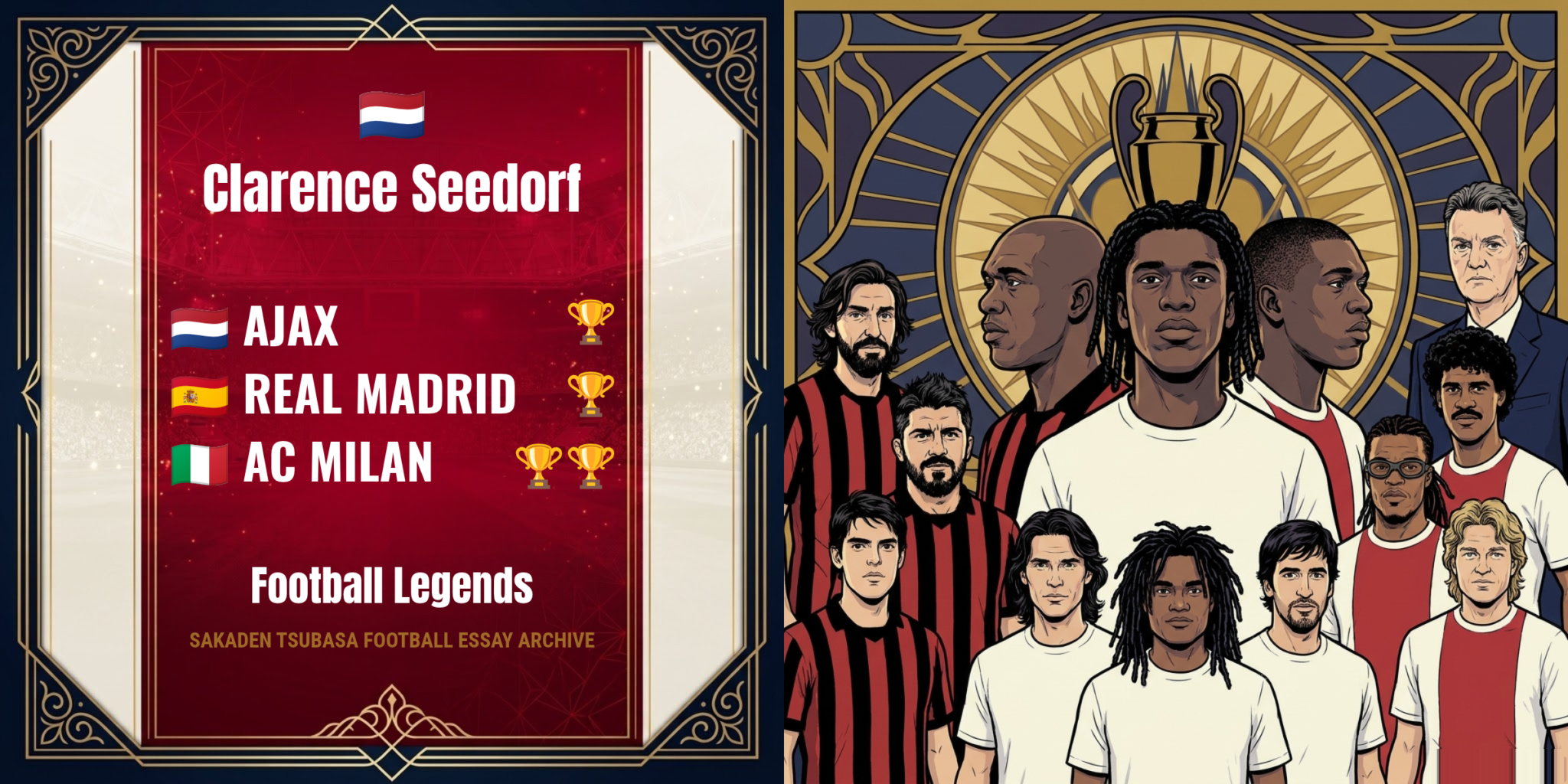
European football’s undisputed “Mr. Almighty”, he remains the only player in history to lift the UEFA Champions League four times with three different clubs.
Let’s dive straight into his profile, playing style, and the remarkable football intelligence that sustained him at the very top for two decades.
- My Encounter with Seedorf | Captain Tsubasa, USA ’94 & Van Gaal’s 1994–95 Ajax
- Profile | Clarence Seedorf: Position, Career Stats & Honours
- Style of Play | What Made Him Unstoppable? The Complete Midfielder
- Attribute Ratings | 5-Point Scale
- Club Career & Triumphs | 4 Champions League Titles Across 3 Clubs
- International Career | Glory, Heartbreak, and the Magic of France ’98
- Tactical Web | The Legends Who Shaped Clarence Seedorf
- Philosophy & Mentality | The 3 Principles Behind “Mr. Almighty”
- Summary | The Blueprint of the Modern Complete Midfielder
My Encounter with Seedorf | Captain Tsubasa, USA ’94 & Van Gaal’s 1994–95 Ajax
My own obsession with football was sparked by three things coming together: the manga Captain Tsubasa, the drama of the 1994 FIFA World Cup in the United States, and Louis van Gaal’s revolutionary 1994–95 AFC Ajax side.
Watching that fearless young Ajax team take apart European royalty was a revelation. Right at the heart of it all stood a teenage dynamo: Clarence Seedorf.
Even at 18, he seemed to cover every blade of grass at once—breaking pressing lines with crisp ground passes, throwing himself into physical duels without flinching, and unleashing dipping long-range strikes whenever opponents gave him half a yard. Seeing him dictate games at that age left an impression I have never forgotten.
Profile | Clarence Seedorf: Position, Career Stats & Honours
| Category | Career Benchmarks & Historical Data |
|---|---|
| ① Full Name | Clarence Clyde Seedorf |
| ② Nationality (& Roots) | Netherlands (Born in Paramaribo, Suriname) |
| ③ Date of Birth | 1 April 1976 |
| ④ Height / Weight | 1.77 m (5 ft 10 in) / 80 kg (176 lbs) |
| ⑤ Preferred Foot | Right |
| ⑥ Primary Roles | Central Midfielder (Mezzala / Box-to-Box) / Holding Midfielder (Pivot) / Attacking Midfielder (Trequartista / No. 10) |
| ⑦ Domestic League Career | • 1992–1995: AFC Ajax (Netherlands / 65 appearances, 11 goals)• 1995–1996: Sampdoria (Italy / 32 appearances, 3 goals)• 1996–2000: Real Madrid (Spain / 121 appearances, 15 goals)• 2000–2002: Inter Milan (Italy / 64 appearances, 8 goals)• 2002–2012: AC Milan (Italy / 300 appearances, 47 goals; 432 apps, 62 goals across all competitions)• 2012–2014: Botafogo (Brazil / 58 appearances, 16 goals; 81 apps, 24 goals total)Total Official Club Career: 890 appearances, 135 goals (640 league apps, 100 goals) |
| ⑧ International Career | Netherlands National Team (1994–2008): 87 caps, 11 goals |
| ⑨ Major Tournament Record | 1998 FIFA World Cup France (Semi-Finals, 4th place / 6 appearances)UEFA Euro 1996 (Quarter-finals), Euro 2000 (Semi-Finals), Euro 2004 (Semi-Finals) |
| ⑩ Iconic Shirt Numbers | Club: No. 6 & No. 8 (Ajax), No. 10 (Real Madrid), No. 10 & No. 20 (AC Milan), No. 10 (Botafogo)Country: No. 8 & No. 10 (Netherlands) |
| ⑪ Major Club Honours | • UEFA Champions League: 4 titles (1994–95 Ajax, 1997–98 Real Madrid, 2002–03 & 2006–07 AC Milan) — the only player in history to win it with three different clubs• Domestic League Championships: Eredivisie (1993–94, 1994–95), La Liga (1996–97), Serie A (2003–04, 2010–11)• Intercontinental Cup: 1 title (1998 Real Madrid)• FIFA Club World Cup: 1 title (2007 AC Milan)• UEFA Super Cup: 2 titles (2003, 2007 AC Milan)• Domestic Cups: KNVB Cup (1992–93), Johan Cruijff Shield (1993), Supercopa de España (1997), Coppa Italia (2002–03), Supercoppa Italiana (2011), Campeonato Carioca (2013) |
| ⑫ Major Individual Honours | • UEFA Club Best Midfielder: 2006–07• UEFA Team of the Year: 2002, 2007• ESM Team of the Year: 1996–97• FIFA 100• AC Milan Hall of Fame• Knight of the Order of Orange-Nassau |
Style of Play | What Made Him Unstoppable? The Complete Midfielder
If you had to sum up Clarence Seedorf in a single phrase, he was the quintessential complete midfielder—”Mr. Almighty” incarnate.
In modern football, midfielders are often categorised into rigid moulds: ball-winning destroyers, deep-lying playmakers, box-to-box runners, or luxury No. 10s. Seedorf tore up those boundaries. He was a complete midfield system in one player, defined by two overarching traits:
- Total Versatility: The ability to adapt seamlessly to any tactical role—like a cutting-edge smartphone built to run every app at the highest level.
- The Ultimate “Water Carrier” (Portaborraccia): Despite possessing elite technical quality, he did the unglamorous defensive work without complaint—like the indispensable backstage crew making sure the lead actors shine under the spotlight.
Beneath that versatility sat two core tactical pillars:
1. Optimal Ball Placement and “First Touch & Release”
Seedorf’s greatest weapon was never flashy showboating or unnecessary stepovers. It was his mastery of what Japanese coach and tactician Yahiro Kazama calls “optimal ball placement”—the art of controlling the ball and releasing it in one fluid motion.
No matter the pace of the pass or the intensity of the press, Seedorf cushioned the ball on his first touch into the exact spot where a pass, dribble, or shot was available within a split second. In video-game terms, he was always in an invincible stance with every command button unlocked.
For defenders, this caused instant hesitation. Because Seedorf never telegraphed his next move and could fire an incisive pass off either foot with minimal back-lift, opponents were frozen on their heels, unable to commit their weight.
Backed by his famously muscular thighs and an iron core, Seedorf was almost impossible to knock off balance. Even under heavy contact from Serie A’s toughest tacklers, his posture never collapsed and the ball stayed glued to his feet.
2. Elite Football IQ and Positional Play
In the framework of Pep Guardiola’s positional play (Juego de Posición), Clarence Seedorf stands as the ideal prototype.
He did not just play the game; he read it two steps ahead. When his side were pinned back by a high press, he dropped alongside the holding midfielder to offer an immediate passing lane, recycling possession with crisp one-touch distribution.
The moment opponents pushed numbers forward, Seedorf spotted the vacated space and drove into the half-spaces—the pockets—to thread line-breaking passes or attack the edge of the box. He played as if viewing the pitch from above, manipulating defensive blocks through positioning alone.
Attribute Ratings | 5-Point Scale
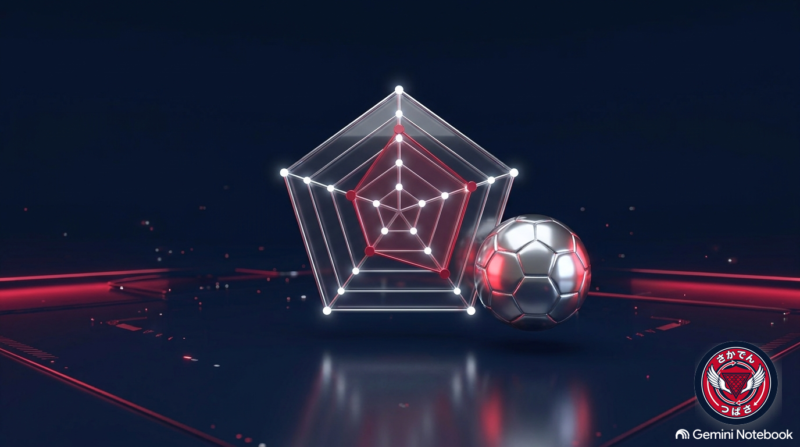
| Attribute | Rating | Notes / Breakdown |
|---|---|---|
| Attacking | ★★★★☆ (4/5) | Powerful long-range shooting, well-timed late runs into the box, and sharp final-third vision. |
| Defending | ★★★★☆ (4/5) | Strong ball recovery, disciplined pressing, and smart positional cover. |
| Technique | ★★★★★ (5/5) | Immaculate first touch, two-footed passing range, and press-resistant ball retention. |
| Pace / Acceleration | ★★★★☆ (4/5) | Powerful ball-carrying through central areas, deceptive burst of pace, and long-striding acceleration. |
| Physicality / Core | ★★★★★ (5/5) | Elite ball shielding, immense lower-body strength, and unshakeable balance under pressure. |
*Note: Ratings represent Sakaden Tsubasa’s independent assessment based on his peak years in European football.
Club Career & Triumphs | 4 Champions League Titles Across 3 Clubs
What elevates Clarence Seedorf into football’s all-time pantheon is a record that still stands alone: winning four UEFA Champions League titles with three different clubs.
To appreciate the scale of that feat, consider the tactical and cultural gulf between Amsterdam, Madrid, and Milan. It is like moving between three elite institutions with completely different philosophies—Dutch Total Football, Spanish flair, and Italian tactical rigour—and leading every single one of them to European glory.
1. AFC Ajax (1992–1995) | European Champion at 19
A product of Ajax’s famed De Toekomst academy, Seedorf made his senior debut at just 16 years and 242 days—becoming the club’s youngest-ever debutant at the time.
Under Louis van Gaal, the 1994–95 Ajax side became the blueprint for synchronised positional play. Playing alongside Frank Rijkaard, Edgar Davids, Jari Litmanen, Marc Overmars, Patrick Kluivert, Frank de Boer, and Edwin van der Sar, Seedorf controlled midfield sequences with a maturity far beyond his 19 years.
On 24 May 1995 in Vienna, Ajax defeated Fabio Capello’s formidable AC Milan 1–0 in the Champions League final. At 19, Seedorf had conquered Europe, anchoring a side that went the entire Eredivisie and Champions League campaigns unbeaten.
2. Real Madrid (1996–2000) | Ending the 32-Year Wait (La Séptima)
After an impressive transitional season in Serie A with Sampdoria, Seedorf was hand-picked by Fabio Capello to join Real Madrid in 1996, taking the prestigious No. 10 shirt.
Slotted into the heart of Madrid’s midfield alongside Argentine maestro Fernando Redondo, Seedorf provided the drive, tactical balance, and physical edge needed to unleash Raúl González and Davor Šuker.
On 20 May 1998 at the Amsterdam Arena—back on Dutch soil—Seedorf helped Real Madrid beat Juventus 1–0 to lift La Séptima, ending the club’s 32-year wait for the European Cup. At just 22, he had conquered Europe with a second continental giant.
3. AC Milan (2002–2012) | The Golden Diamond & Two European Crowns
After crossing the Milan divide from Inter in 2002, Seedorf entered the defining chapter of his career under Carlo Ancelotti.
Ancelotti built one of football’s most iconic midfields: the 4-3-1-2 diamond. Andrea Pirlo dictated from deep as the regista; Gennaro Gattuso patrolled as the relentless ball-winner; Rui Costa—and later Kaká—operated in the hole as the trequartista; and Seedorf anchored the left as the complete mezzala.
If Pirlo was the conductor setting the melody and Gattuso was the percussion driving the beat, Seedorf was the virtuoso multi-instrumentalist—able to hit any note, fill any gap, and change the tempo at will.
- 2002–03 Season (Historic Milestone): Beating Juventus on penalties at Old Trafford after a 0–0 draw, Seedorf etched his name into history as the first and only player to win the Champions League with three different clubs.
- 2006–07 Season (The Masterpiece): Avenging the 2005 Istanbul heartbreak with a 2–1 win over Liverpool in Athens. Wearing the No. 10 shirt, Seedorf delivered commanding displays throughout the run—including the famous 3–0 semi-final demolition of Manchester United at San Siro—and was named UEFA Club Best Midfielder.
In 2012, Seedorf embarked on a final playing chapter with Botafogo in Brazil. Proving his football intelligence travelled anywhere, he guided the Rio club to the 2013 Campeonato Carioca title before hanging up his boots.
4. The Common Formula Behind All Three European Triumphs
At first glance, those three Champions League-winning sides—Ajax, Real Madrid, and AC Milan—appeared to have completely different identities. Look closer, however, and they all shared the exact same midfield blueprint:
- A Master Regista: Frank Rijkaard, Fernando Redondo, Andrea Pirlo
- A Relentless Destroyer: Edgar Davids, Christian Karembeu, Gennaro Gattuso
- A Goalscoring Threat: Jari Litmanen, Raúl, Kaká
With Seedorf providing the balance at the heart of that quartet, each of those distinct personalities was free to shine—and that chemistry carried all three clubs to European glory. Above all, playing alongside a world-class regista unlocked Seedorf’s greatest strength: his rare ability to influence both phases of the game, in attack and defence alike.
International Career | Glory, Heartbreak, and the Magic of France ’98
Across 87 caps and 11 goals for the Netherlands (1994–2008), Clarence Seedorf experienced a very different story from his club dominance. While he conquered Europe four times with three different clubs, his journey with the Oranje was a dramatic blend of brilliance and tactical friction.
1. The 1998 FIFA World Cup: A Golden Generation and Heartbreak in Marseille
France ’98 was the only World Cup of Seedorf’s career—and what a stage it was. Managed by Guus Hiddink and built around the Ajax Champions League winners alongside Dennis Bergkamp, Patrick Kluivert, Edgar Davids, and Frank de Boer, this Dutch side was one of the most gifted squads ever assembled.
Starting at the heart of midfield across six appearances, Seedorf anchored the side in the iconic 2–1 quarter-final victory over Argentina, sealed by Bergkamp’s timeless first touch and volley. In the semi-final against holders Brazil, the Dutch went toe-to-toe with Ronaldo and company, drawing 1–1 before falling agonisingly on penalties in Marseille. They missed the final by inches, yet their brand of orange-tinted football remains etched in World Cup folklore.
2. EURO Regrets and Enduring Oranje Pride
Away from France ’98, Seedorf’s international career was often shaped by tactical disagreements with managers and the sheer abundance of Dutch playmakers competing for the same spaces. A missed penalty against France at EURO 1996, followed by semi-final exits at EURO 2000 and EURO 2004, meant international silverware always stayed just out of reach.
Even so, Seedorf’s calm authority, multilingual leadership, and deep tactical voice made him a lasting pillar of Dutch football—respected on and off the pitch long after his final cap.
Tactical Web | The Legends Who Shaped Clarence Seedorf
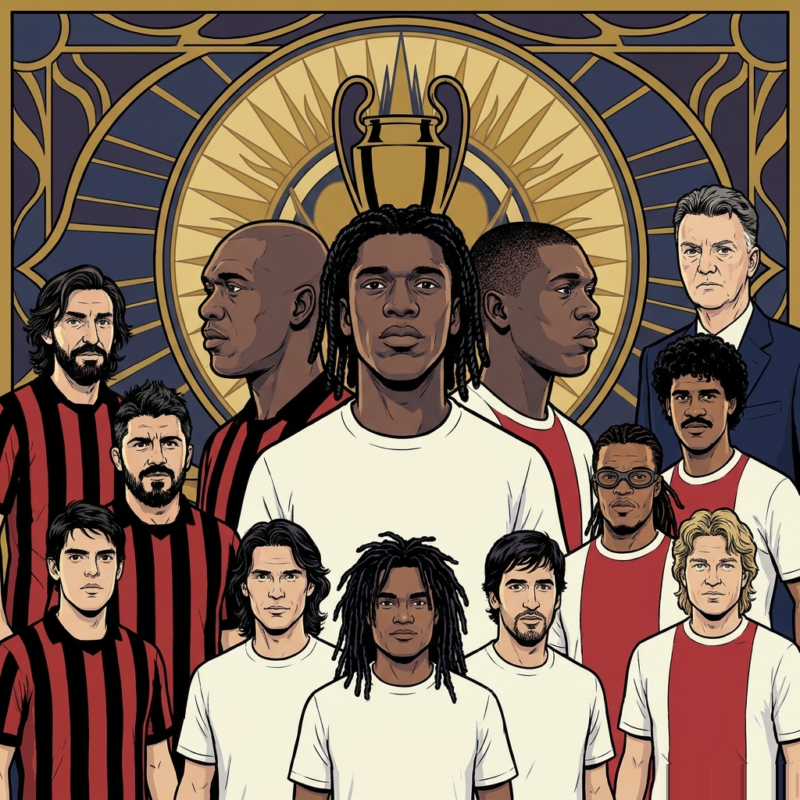
Seedorf’s historic feat of winning the UEFA Champions League with three different clubs did not happen in isolation. At every European giant he joined, his game was forged through extraordinary chemistry with the icons around him.
- Louis van Gaal (Ajax Manager / The Strict Architect): Handed Seedorf his senior debut at 16 and drilled into him the foundations of positional play and clean ball control. Van Gaal’s demand for discipline within creativity built the base of Seedorf’s all-round game.
- Frank Rijkaard (Ajax / The Mentor): Returned to Ajax in 1994–95 to marshal midfield alongside the teenage Seedorf. Sharing Surinamese roots, Seedorf absorbed Rijkaard’s composure, authority, and panoramic view of the pitch up close.
- Edgar Davids (Ajax & Netherlands / The Pitbull & Comrades-in-Arms): A lifelong teammate from the Ajax academy who also shared Surinamese heritage. Davids hunted opponents with relentless energy while Seedorf controlled and distributed—a seamless blend of fire and poise.
- Jari Litmanen (Ajax / The Master Between the Lines): The Finnish No. 10 at the tip of Ajax’s 3-4-3. Seedorf’s crisp vertical passes from deep into Litmanen’s pockets of space tore apart defences across Europe.
- Fernando Redondo (Real Madrid / The Silky Regista): The Argentine maestro who partnered Seedorf in Madrid’s midfield from 1996. Redondo dictated the tempo with effortless grace while Seedorf drove the team forward with power and purpose.
- Christian Karembeu (Real Madrid / The Tireless Ball-Winner): A vital engine behind the 1997–98 La Séptima triumph. Together, Seedorf, Redondo, and Karembeu formed a physically imposing, technically assured midfield trio that neutralised Juventus in the final.
- Raúl González (Real Madrid / The Clinical No. 7): The iconic Spanish forward who led the line during Madrid’s 1997–98 La Séptima triumph. Seedorf’s midfield drive, balance, and incisive passing gave Raúl the platform to drift into dangerous spaces and deliver decisive goals on the biggest nights.
- Andrea Pirlo (AC Milan / The Maestro): The deep-lying conductor at the base of Carlo Ancelotti’s 4-3-1-2 diamond. Operating to his left, Seedorf protected Pirlo and acted as Milan’s second brain whenever opponents tried to shut down the regista.
- Gennaro Gattuso (AC Milan / The Relentless Shield): The fierce ball-winner on the right of Milan’s diamond. Because Gattuso shouldered the gritty defensive battles, Seedorf had the freedom to glide forward from the left and decide matches in the final third.
- Kaká (AC Milan / The Finisher): The Ballon d’Or winner who thrived at the tip of the diamond. Seedorf’s ability to draw markers in midfield and release perfectly weighted through balls unlocked Kaká’s blistering pace, powering Milan to the 2006–07 Champions League crown.
Philosophy & Mentality | The 3 Principles Behind “Mr. Almighty”

1. The Art of the “Water Carrier” (Portaborraccia)
Despite possessing world-class technique, a thunderous long-range shot, and effortless dribbling ability, Seedorf never played simply to steal the spotlight. He embraced what Italians call the portaborraccia—the “water carrier” who does the unglamorous running, plugs gaps in midfield, and wins second balls so the team’s stars can flourish. Setting aside ego in service of collective harmony is why every manager at every giant club trusted him first on the teamsheet.
2. Pure Rationality in “Optimal Ball Placement”
There was never a wasted touch in Seedorf’s game. No matter how fiercely opponents pressed, his first touch placed the ball in the exact spot from which a pass, dribble, or shot could follow in a split second—the essence of what Japanese tactician Yahiro Kazama calls “stop and kick.” When defenders cannot even commit to a tackle, you do not need tricks to beat them. Seedorf sharpened his technique not for show, but to solve problems in the simplest, smartest way possible.
3. Chameleon-Like Adaptability Across Three Football Cultures
The Netherlands (Ajax), Spain (Real Madrid), and Italy (AC Milan). Moving across three clubs with radically different tactical philosophies, tempos, and footballing cultures—and lifting the Champions League at all three—remains a feat no other player has matched. Rather than clinging to past habits, Seedorf read what each new side was missing and became that exact piece. Never blaming his surroundings, he kept evolving.
Summary | The Blueprint of the Modern Complete Midfielder

Clarence Seedorf’s true legacy extends far beyond the four Champions League medals in his trophy cabinet.
He was the blueprint for the modern complete midfielder—proving that physical power and refined technique are never mutually exclusive, and that tactical self-sacrifice is one of the highest forms of football intelligence.
As the modern game grows faster, more intense, and played in ever tighter spaces, the lessons of Seedorf’s career only become more relevant. A player who controls the ball cleanly, reads space instinctively, and works selflessly for the team’s balance will always be the most valuable asset on the pitch.
Watch footage of Clarence Seedorf dictating a match at San Siro or the Bernabéu. Amid the intensity of elite football, you will find the timeless beauty of the game.
Stay curious, stay inspired, and enjoy football with a smile!
👉 Players Archive | Legends & Tactical Profiles
👉 Fantasy XI & Selections Archive | All-Time Lineups & Tactical Experiments